Image: Guillaume Lelarge, Wikimedia Commons, CC BY-SA 3.0
How the hieroglyphic script combines sound signs, word signs, and classifiers, how a line of signs is read, and how Champollion read it in 1822 with the Rosetta Stone, a few royal names, and his knowledge of Coptic. By the end of the unit you read the cartouches of Ptolemy, Cleopatra, Ramesses, and Tutankhamun yourself.
Sample unit: the complete text
For fourteen centuries nobody on Earth could read a line of Egyptian. The temples, the tombs, and the papyri of Unit 1 were covered in writing, and that writing was looked at, copied, admired, and explained in every way except the right one. This unit teaches the script first, as a scribe learned it, and then tells how it was read again in 1822. By the end you will read the names of four rulers in their cartouches yourself.
1 The stone and the state of knowledge in 1800
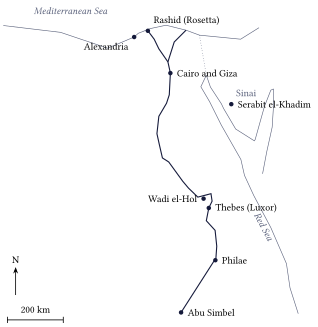
In July 1799, French soldiers were strengthening a fort at Rashid, the town the Europeans called Rosetta, on the western branch of the Nile (Figure 2). During the work they uncovered a slab of granodiorite, a dark and hard stone much like granite, with three bands of writing on one face. The officer of engineers in charge, Pierre-François Bouchard (1771-1822), understood what he was looking at and had it sent to the scholars who had come to Egypt with Napoleon’s army. The Rosetta Stone is 112.3 cm high, 75.7 cm wide, 28.4 cm thick, and weighs about 760 kg, roughly as much as a small car. It is the lower part of a larger stela, an upright slab set up to carry an inscription, and its three texts are, from top to bottom, 14 lines of hieroglyphs with the top of the text broken away, 32 lines of Demotic, and 54 lines of Greek (Figure 1). When the French surrendered Egypt in 1801, the stone passed to the British, and it has stood in the British Museum since 1802.
The Greek could be read at once. It is a decree of the priests of Egypt, gathered at Memphis, in honour of the young king Ptolemy V, dated 27 March 196 BC, and it ends with the order that the decree be carved “in sacred, in native, and in Greek letters” on a stela in every major temple. That last sentence told the scholars what they had: the same text three times, in two scripts nobody could read and one everybody could. Unit 8 places Ptolemy V in his time; in this unit the stone matters only as the tool that opened the script.
What was known about the sacred script in 1800 came from Greek and Roman authors, and most of it was wrong. The Egyptian writer Horapollo, who probably lived in the fifth century AD, when the script was already dying, left a Greek book called the Hieroglyphica with 189 explanations of signs. His manuscript was found on the island of Andros in 1419, was printed in 1505, and shaped European thinking for three centuries. Some of his statements rest on real knowledge. The vulture does write the word “mother”, for example, because the Egyptian word for mother, mwt, was spelled with the vulture sign. His explanation, however, was that vultures are all female, so the bird signifies motherhood. In the same way he explained every sign as a symbol of an idea, and his readers concluded that hieroglyphs were a philosophical picture code and not a way of writing a language. The Jesuit Athanasius Kircher (1602-1680) built on this belief in his Oedipus Aegyptiacus of 1652 to 1654, in which he translated the signs on the obelisks of Rome into long mystical sentences that have no connection to the inscriptions at all. Kircher did leave one useful idea behind. He studied Coptic, the language of the Egyptian Christians, and argued that it was the last form of the language of the pharaohs. That idea was right, and Section 4 shows how Coptic became one of the three keys to the decipherment.
Figure 1. The Rosetta Stone in the British Museum. The hieroglyphic text at the top is the least complete, the Demotic in the middle is nearly complete, and the Greek at the bottom is complete except for its lower right corner. Credit: Hans Hillewaert, Wikimedia Commons, CC BY-SA 4.0.Figure 2. The places of this unit, drawn from their coordinates: Rashid, where the stone was found, Alexandria, Philae with its obelisk and its last inscription, Abu Simbel with the cartouches of Ramesses, Serabit el-Khadim with the Proto-Sinaitic inscriptions, and Wadi el-Hol, where two more early alphabetic inscriptions were found in 1993. The Nile and the coasts are simplified.
2 Sounds, words, and classifiers
The signs of the hieroglyphic script are pictures, and that is exactly what misled Horapollo’s readers. A picture can be used in writing in two ways. It can stand for the thing it shows, and it can stand for the sound of the word for that thing. English children play the second game when they write “I can see” with an eye, a tin can, and the sea, and Egyptian scribes played it from the beginning of their writing, in the labels from the tomb U-j at Abydos of about 3300 BC that Unit 2 introduces.
The Egyptian script made the rebus principle more powerful by one decision. The script records only the consonants of a word and leaves out the vowels. The duck therefore does not write the sounds of “pintail duck” with their vowels; it writes the consonant skeleton z-ꜣ, and any word with that skeleton can borrow it. Unit 1 explained what this means for modern readers, namely that every spelling such as “Khufu” or “Tutankhamun” is a convention with the vowels guessed. The Evidence in Detail box below gives the reasons for being sure that the vowels were left out of the writing and were not absent from the spoken language.
A sign used for its sound is a phonogram. Phonograms come in three kinds, sorted by the number of consonants they write. A uniliteral sign writes one consonant, such as the owl, G17, which reads m, or the water line, N35, which reads n (the codes are those of the standard sign list, which is explained at the end of this paragraph). A biliteral sign writes two consonants, such as the house plan, O1, which reads pr. A triliteral sign writes three, such as the sign of the windpipe and heart, F35, which reads nfr. There are about 25 uniliteral signs, which Section 3 presents in full, about 80 biliteral signs in common use, and a few dozen triliterals. Together the signs in regular use in the Middle Kingdom number about 700 to 900. The standard list of them was first printed by Alan Gardiner (1879-1963) in his grammar of 1927, and its final edition of 1957 has 763 signs sorted into 26 groups. The codes such as G17 and N35 come from that list: the letter names the group and the number is the sign’s place inside it. In the temples of the Ptolemaic Period the scribes multiplied the signs to more than 5,000, which is one reason the latest inscriptions are among the hardest.
A sign that stands for the thing it shows is a logogram, a word sign. The house plan, O1, used as a logogram writes pr “house”, and a scribe usually marked this use with a short vertical stroke, Z1, under or beside the sign. Figure 3 shows the same house plan in both roles. As a logogram with the stroke it is the word “house”. As a phonogram it supplies the consonants p-r to the verb prỉ “to go out”, which has nothing to do with houses, and the walking legs at the end of that word tell the reader which word is meant.
Those legs are the third kind of sign. A determinative is a sign placed at the end of a word that is not read aloud and that tells the reader what class of thing the word belongs to: a man for names and persons, a pair of legs for words of motion, a sealed papyrus roll for abstract ideas, a town plan for places, three strokes for a plural. Figure 4 shows ten of the commonest. Many Egyptologists now call them classifiers, because that is what they do; the unit uses both words. Determinatives make up for the missing vowels. A skeleton of consonants such as pr could be several words, and the determinative sorts them out, as the walking legs do for “go out”. They also mark where one word ends and the next begins, since the script uses no spaces between words.
Figure 3. Eight words that show the three functions of a sign. Each row gives the signs, the transliteration, the meaning, and the role of each sign. Rendered from the font Noto Sans Egyptian Hieroglyphs.
One last device completes the toolkit. A biliteral or triliteral sign is often followed by one or two uniliteral signs that repeat part of its sound. In nfr, the triliteral F35 is followed by the horned viper f and the mouth r, and the word is still read nfr, with three consonants and not five. These helpers are phonetic complements. They tell the reader which of several possible values a sign has, they make the word recognizable at a glance, and they neatly fill the imaginary square into which a scribe fitted his signs, a habit that Section 3 explains.
Figure 4. Ten common determinatives with their Gardiner codes and the class of meaning each marks. Rendered from the font Noto Sans Egyptian Hieroglyphs.
The pictures of the script had one more consequence, which was that people who could not read Egyptian could still recognize the pictures. In Egypt perhaps one in a hundred people could read and write. Outside Egypt, in Sinai, that gap between seeing and reading is where the research spotlight of this unit places the invention of the alphabet.
3 Reading a line
Figure 5 shows the uniliteral signs in the order of the Leiden list of Unit 1, with their Gardiner codes. They are the signs a beginner learns first, because every foreign name and many Egyptian words are spelled with them alone, and because the complements of the bigger signs are taken from them. Two of the values need a note. The vulture ꜣ and the forearm ꜥ stood for sounds that English does not have, the second of them made deep in the throat; Egyptologists speak both as a. The reed leaf ỉ is written j in the grammar of the American Egyptologist James Allen and in many German books, and the hill slope q is written ḳ in Gardiner’s grammar; the values are the same, only the letters differ.
Figure 5. The uniliteral signs with their Leiden values, Gardiner codes, and the objects they show. The two reeds and the two strokes both write the sound y, which the Leiden list writes as y and ï. Rendered from the font Noto Sans Egyptian Hieroglyphs.
Signs can be written in horizontal lines or in vertical columns, and a line can run from left to right or from right to left. The script has no fixed direction, and this freedom was used on purpose: on the two sides of a doorway the signs usually face the opening, so that both inscriptions begin at the door and run away from it. The reader is never left to guess, because the signs themselves say where to begin.
The first rule is the one a museum visitor uses most. It also explains a convention of this unit: the plates (the figures that show rows of signs) and the interactive element show the signs facing left, so they are read from left to right, in the direction of English. On the monuments, by contrast, the inscriptions far more often face right and are read from right to left (Figure 6). The second and fourth rules explain why a printed line of hieroglyphs does not look like a row of letters. A scribe who had to write the loaf t above the stool p would never leave half a square empty; the flat signs share the space, and the eye of the reader learns to take a square at a time.
Figure 6. The name of Ptolemy in three arrangements: (a) facing left and read from the left, (b) mirrored, facing right and read from the right, and (c) in a column, read from the top, where the loaf shares a square with the stool and the two reeds share another. The bar at the end of each cartouche marks the end of the reading direction. Rendered from the font Noto Sans Egyptian Hieroglyphs.
4 The decipherment
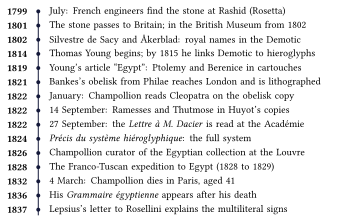
Figure 7. The decipherment of the Egyptian scripts from the find of the stone to the explanation of the multiliteral signs, with the dates of each step.
The decipherment was done by a chain of people over 23 years, and Figure 7 lists the steps. Copies of the stone’s three texts were printed in Paris and London from 1800, and the first results came from the Demotic, the middle text, because it was nearly complete and because its signs, which look like a cursive alphabet, invited the methods used for other unknown scripts. In 1802 the French orientalist Antoine-Isaac Silvestre de Sacy (1758-1838) found the groups of Demotic signs that had to be the names Ptolemy, Alexander, and Arsinoe, by counting where the names stood in the Greek and looking at the same places in the Demotic. In the same year the Swedish diplomat Johan David Åkerblad (1763-1819) went further and proposed an alphabet of 29 Demotic signs, of which about half were right, and read several Egyptian words in the Demotic with the help of Coptic. Both men then stopped, Sacy because he believed the Demotic was not purely alphabetic, which was true, and Åkerblad because he believed it was, which was not.
The next step was taken in England by Thomas Young (1773-1829), a physician whose experiments had shown that light is a wave. Young began on the stone in 1814 and soon noticed that many Demotic signs were simplified forms of hieroglyphs, so that the two scripts were one system in two styles. He then did what Sacy had done, but with the hieroglyphs: he located the cartouche of Ptolemy, matched its signs to the sounds of the Greek name, and from a copy of an inscription of Ptolemy and his queen Berenice did the same for her name. In the article “Egypt” that he wrote in 1818 for the supplement of the Encyclopaedia Britannica, published in 1819, Young proposed 13 sign values, of which six were right and three partly right, and he recognized the ending that marks a woman’s name. He also drew the wrong general conclusion. Young believed that hieroglyphs wrote sounds only when a foreign name had to be fitted into the script, and that Egyptian words themselves were written symbolically, as Horapollo had said.
The man who proved otherwise was Jean-François Champollion (1790-1832), born at Figeac in southern France, a student of Sacy’s in Paris, and a reader of Coptic since his teens. Champollion’s method rested on three things, which the Key Idea below names, and the first two came together in a lithograph, a printed copy of an inscription, that reached him in January 1822. The English traveller William John Bankes (1786-1855) had found an obelisk at Philae in 1815. Its base carries a Greek inscription naming a Ptolemy and a Cleopatra, and its shaft carries two cartouches. Bankes had the obelisk shipped to his house in Dorset, where it still stands. He had the inscriptions lithographed, and a copy went to Paris. Champollion now had two cartouches with four signs in common, and the first two worked cases below follow his reading of them.
Figure 8. The five cartouches of this unit with the signs numbered in reading order: Ptolemy as on the Rosetta Stone, Cleopatra as on the Philae obelisk, Ramesses and Thutmose as Champollion read them in 1822, and the birth name of Tutankhamun with its epithet. The signs are set in a line for clarity; on the monuments the flat signs share squares. Rendered from the font Noto Sans Egyptian Hieroglyphs.
By the summer of 1822 Champollion had used the same method to read a dozen more Greek and Roman names, among them Alexander, Berenice, Caesar, and Trajan, and had an alphabet of about twenty values. All of them were foreign names, and he still shared Young’s doubt about Egyptian words. The doubt ended on 14 September 1822, when the architect Jean-Nicolas Huyot (1780-1840) sent him copies of inscriptions from the rock temple of Abu Simbel in Nubia, far up the Nile (Figure 2), a temple that no Greek king had built, so that any name in its cartouches had to be Egyptian.
The Lettre dealt only with Greek and Roman names. In the Précis du système hiéroglyphique of 1824 Champollion laid out the whole system, sound signs, word signs, and determinatives together, in his words “figurative, symbolic, and phonetic at the same time, in the same text, the same sentence, and almost the same word”. He read the list of kings that Bankes had found at Abydos, led an expedition to Egypt in 1828 and 1829, and died in Paris on 4 March 1832 at 41, with his grammar and dictionary unpublished; the grammar appeared in 1836. One correction was still to come. Champollion had treated most signs as single-sound signs, a large alphabet in which many signs were alternatives for the same sound. In a letter to the Italian Egyptologist Ippolito Rosellini published in 1837, Karl Richard Lepsius (1810-1884) showed that many of them were biliteral and triliteral signs with complements, as Section 2 described them, and reduced the true alphabet to about thirty signs.
5 Hieratic, Demotic, and the end of the script
Hieroglyphs were the script of stone. A scribe writing a letter, an account, or a story on papyrus with a reed brush and ink did not draw an owl with every feather. From the first dynasties the Egyptians used a cursive form of the same system in which each sign became a few quick strokes, and this cursive is called hieratic, from the Greek word for “priestly”. The name comes from the end of the script’s life: when the Greek writer Clement of Alexandria (about AD 150-215) described the Egyptian scripts, hieratic was by then used mostly by priests for religious books. Clement named three kinds of Egyptian writing, the letter script of daily life (which is the Demotic described below), the hieratic, and the hieroglyphic, and his names have remained in use. Figure 9 shows the relation between a hieroglyph and its hieratic forms on a plate of the reference work that Egyptologists still use.
Figure 9. Four rows of plate 8 in volume II of Georg Möller’s Hieratische Paläographie (1909): the hieroglyph in the first column (the nose, the eye, the painted eye, and the eyebrow) and its hieratic forms in ten manuscripts of the New Kingdom and the Twenty-first Dynasty, named in the column headings, from the reign of Thutmose III on the left to the Twenty-first Dynasty on the right. Credit: Georg Möller, 1909, public domain, via Wikimedia Commons.
Hieratic has three features a reader must know. It is always written from right to left, whatever the monuments do. It is a script of ligatures, in which neighbouring signs run together and a sign changes its shape with its neighbours, so that it has to be learned as a script in its own right and not as a shorthand that any reader of hieroglyphs can follow. And it is the script in which nearly all Egyptian literature, science, and administration survives: the Tale of Sinuhe, the medical and mathematical papyri, the records of the tomb builders of Deir el-Medina in Unit 7, and the letters of ordinary people were all written in hieratic. Hieroglyphs, by contrast, were for monuments and for texts meant to last, such as the Book of the Dead of Unit 6, which was often written in a careful form halfway between the two.
Around 650 BC, in the Nile Delta under the Twenty-sixth Dynasty, a still faster cursive developed out of the form of hieratic that the offices of the north used for business, and it spread over the whole country within a few generations. The Greeks called it Demotic, “popular”, a name that Herodotus (about 484-425 BC) already uses. In Demotic the signs are so far from their pictures that even an Egyptologist cannot see the owl in the stroke that writes m, and groups of signs became fixed spellings of whole words. Demotic was the script of contracts, letters, tax receipts, and, from the Ptolemaic Period, of stories and religious texts too. It is the middle text of the Rosetta Stone, and it is what the Greek decree means by “native letters”. Table 1 sets the four scripts side by side.
Script
In Use
Direction
Typical Use
Hieroglyphic
3300 BC to AD 394
either
monuments, tombs, temples
Hieratic
3000 BC to AD 250
right to left
letters, accounts, literature
Demotic
650 BC to AD 452
right to left
contracts, receipts, letters
Coptic
AD 250 to today
left to right
Christian texts, the liturgy
Table 1. The four scripts of the Egyptian language. The dates are approximate and are those of the earliest and latest known texts; hieratic survived in religious books into the third century AD, and Coptic is still read aloud in the services of the Coptic Church.
The script did not die all at once. Greek became the language of government after Alexander the Great conquered Egypt, and by the end of the third century BC a Demotic contract needed a Greek note of registration to be valid. Under Roman rule Demotic withdrew from public life altogether. Knowledge of hieroglyphs shrank to the temples, where the priests kept carving and even multiplied the signs, and the temples themselves lost their income and their standing as Egypt became Christian. The Egyptian Christians kept the language and dropped the script. From the third century AD they wrote Egyptian in the Greek alphabet with six or seven extra letters borrowed from Demotic for sounds that Greek lacked, and this Coptic script, with vowels at last, is the one in which the last stage of the language survives.
6 Reading royal names
A reader who has followed the unit this far can read cartouches, and the best place to try is the most famous royal name of all. The last row of Figure 8 is the birth name of Tutankhamun, and it shows one more rule of the script.
The names in cartouches are the easy part of the script, because they are short, their owners are known, and their signs are mostly uniliterals. Reading a sentence needs the grammar, which lies beyond this unit.
This is one of 16 units
Participants also get the quiz, the further reading, and the final exam.