The Seated Scribe from Saqqara in profile, painted limestone with inlaid eyes, on a black ground

Egyptology Masterclass12-Week Program in Egyptology

Study ancient Egypt one unit per week, with the first kings, the pyramids, hieroglyphs, and the tomb of Tutankhamun.

  • Certificate
  • Online
  • Join a community of 2500+

The Seated Scribe

Painted limestone, inlaid eyes. Saqqara, Old Kingdom, about 2600 to 2350 BC.

Musée du Louvre, Paris, E 3023

Photograph: Rama, CC BY-SA 3.0 FR

Our alumni study at

The gold funerary mask of Tutankhamun with lapis lazuli and carnelian inlays, in its case in Cairo

Funerary mask of Tutankhamun

Gold, inlaid with lapis lazuli, carnelian, quartz, obsidian, and coloured glass. Valley of the Kings, tomb KV62, Eighteenth Dynasty, reign of Tutankhamun, about 1336 to 1327 BC.

Egyptian Museum, Cairo, JE 60672

Photograph: Roland Unger, public domain

About the program

The Egyptology Masterclass takes you through ancient Egypt one unit at a time. You enrol, and from then on a new unit reaches you every week. Each unit is a chapter written for this program, with primary sources in translation, worked readings of objects and inscriptions, and the research of Egyptologists who are active today.

A quiz completes every unit and opens the next. At the end you sit a final exam and receive an official certificate.

  • Structured. A fixed curriculum that starts with the Nile and the first kings and ends with inscriptions read in the original.
  • Demanding and fair. Primary sources and real hieroglyphs, with every step of an argument shown.
  • Recognized. An official certificate and transcript with a public verification page.
How the program works

Who is this program for?

For high school students, university students, and lifelong learners. You need no prior knowledge of Egypt and no ancient language: Unit 1 gives every participant the same toolkit.

High School Students

You want to understand ancient Egypt properly and get ahead early. The masterclass supports university applications, an Extended Essay or EPQ, and history competitions.

  • No prior knowledge needed
  • Certificate for applications
  • Read your first hieroglyphs

University Students

A supplement to a degree in archaeology, history, classics, or anthropology. Use it to prepare for Egyptology modules, a dissertation, or a first field season.

  • Primary sources in translation
  • Current research papers
  • A base for a dissertation

Lifelong Learners

You have walked through the Egyptian galleries in London, Berlin, Turin, or Cairo. The masterclass puts what you know in order and shows how Egyptologists reach their conclusions.

  • No deadlines, pause any time
  • Every term explained
  • Read on screen or as PDF

How does it work?

From enrolment to certificate in six steps, in the order you meet them.

  1. Step 1

    Enrol

    Create your account with your email address, choose your masterclass, and pay the Tuition Fee. Your program starts at once.

  2. Step 2

    Receive your unit

    Unit 1 arrives immediately, every further unit on a Monday: as a web page and as a PDF to keep.

  3. Step 3

    Study

    Work through the text, the sources, and the worked readings. A day later we send further reading with current research papers.

  4. Step 4

    Take a quiz for every unit

    Each unit has its own quiz: ten questions, open book, no time limit. You submit it before the next unit is sent to you.

  5. Step 5

    Sit the final exam

    50 questions across all units of your masterclass in 60 minutes, open book. Pass with 70%.

  6. Step 6

    Earn your certificate

    Certificate and transcript as PDF, each with a verification ID and a personal link you can share.

Topics

16 units in three rooms. Foundation covers Units 1 to 8, Advanced continues to Unit 12, and Advanced + Hieroglyphic Texts adds Units 13 to 16.

The pyramids of Menkaure, Khafre, and Khufu at Giza, with three queens' pyramids in front

Units 1 to 8, in all three masterclasses

Egypt from the Ground Up

How the Nile made a state, how the script works, how the pyramids were built, what the Egyptians believed about gods and death, and how ordinary people lived.

  1. 1The Egyptologist's Toolkit
  2. 2The Nile and the First Kings
  3. 3Hieroglyphs and Their Decipherment
  4. 4The Pyramid Age
  5. 5Gods, Kings, and Temples
  6. 6Death and the Afterlife
  7. 7Life in the Black Land
  8. 8Three Thousand Years of Egypt

The Great Pyramid of Khufu, 146.6 metres high when finished, remained the tallest building on Earth for about 3,800 years.

Shown: the pyramids of Menkaure, Khafre, and Khufu. Limestone. Giza, Fourth Dynasty, about 2590 to 2500 BC. Photograph: Ricardo Liberato, CC BY-SA 2.0

Aerial view at sunrise of the terraced temple of Hatshepsut at Deir el-Bahari below the cliffs

Units 9 to 12, in Advanced and Advanced + Hieroglyphic Texts

Kingdoms, Literature, and Empire

The literature of the Middle Kingdom, the conquests of the New Kingdom, Akhenaten's experiment and its end, and the last pharaohs under Greek and Roman rule.

  1. 9The Middle Kingdom and Its Literature
  2. 10The New Kingdom Empire
  3. 11Amarna and Tutankhamun
  4. 12Late Egypt, the Ptolemies, and Rome

Cleopatra VII lived closer in time to the first Moon landing than to the building of the Great Pyramid.

Shown: the temple of Hatshepsut. Limestone terraces below the cliffs. Deir el-Bahari, Luxor, Eighteenth Dynasty, about 1473 to 1458 BC. Photograph: Diego Delso, CC BY-SA 4.0

Columns of hieroglyphs, stars, and a row of deities in gold on the near-black astronomical ceiling of the tomb of Sety I

Units 13 to 16, in Advanced + Hieroglyphic Texts

Reading the Hieroglyphic Texts

Middle Egyptian grammar built step by step, then the Tale of Sinuhe, spells of the Book of the Dead, and royal inscriptions, each read in the original from sign plates.

  1. 13Middle Egyptian Grammar
  2. 14The Tale of Sinuhe in the Original
  3. 15Spells of the Book of the Dead
  4. 16Royal and Temple Inscriptions

The last dated hieroglyphic inscription was carved at Philae on 24 August AD 394. Nobody could read the script again until 1822.

Shown: the astronomical ceiling of the burial chamber of Sety I. Painted plaster on limestone. Valley of the Kings, tomb KV17, Nineteenth Dynasty, about 1294 to 1279 BC. Photograph: Carole Raddato, CC BY-SA 2.0

Full curriculumAll 16 units with their summaries
  1. Unit 1

    The Egyptologist's Toolkit

    The geography of the Nile valley, the dynasties and how they are dated, the kinds of evidence Egyptologists use, and the conventions for writing Egyptian words in our alphabet. The unit also fixes the Egyptian measures of length, grain, and value that every later unit uses.

  2. Unit 2

    The Nile and the First Kings

    How farming villages along the river grew into the Naqada cultures, and how the first kings united Egypt about 3100 BC, as the Narmer Palette records. The unit shows how Petrie put pottery in order before any dates were known, what the labels of tomb U-j say about the beginnings of writing, and how radiocarbon now dates the First Dynasty.

  3. Unit 3

    Hieroglyphs and Their Decipherment

    How the hieroglyphic script combines sound signs, word signs, and classifiers, how a line of signs is read, and how Champollion read it in 1822 with the Rosetta Stone, a few royal names, and his knowledge of Coptic. By the end of the unit you read the cartouches of Ptolemy, Cleopatra, Ramesses, and Tutankhamun yourself.

  4. Unit 4

    The Pyramid Age

    The Old Kingdom pyramids in the order they were built: Djoser's steps at Saqqara, Sneferu's three experiments, and Khufu's Great Pyramid at Giza with its chambers, boats, and workers' town. The unit works out the volume of the Great Pyramid and the blocks its builders placed each day, turns a week of the logbook of the inspector Merer into tonnes of stone, estimates the meat the builders ate from their rubbish, and explains how the pyramids were aligned to true north.

  5. Unit 5

    Gods, Kings, and Temples

    Egyptian religion as a working system: maat, the order the gods and the king kept running; the gods as a population that could combine without merging; the king as the one priest with five names; and the temple as the house of a god, walked from pylon to sanctuary and followed through a day of its ritual. The unit turns the figures of the Great Harris Papyrus into a share of Egypt's farmland and ends with how ordinary people spoke to gods who lived behind closed doors.

  6. Unit 6

    Death and the Afterlife

    What the Egyptians did about death and why: the parts of a person and what each needed, mummification as the bodies and the chemists show it against the account of Herodotus, the tomb as a machine that kept the dead supplied, the funerary texts from the pyramid of Unas to the Book of the Dead, and the judgement before Osiris. The unit reads the judgement scene of the papyrus of Hunefer figure by figure, prices a coffin from the receipts of Deir el-Medina, and follows the inspectors of year 16 of Ramesses IX through the robbed tombs of Thebes.

  7. Unit 7

    Life in the Black Land

    Farming and the annual flood, households, law, and work, with the tomb builders' village of Deir el-Medina as one of the best documented communities of the ancient world. The unit reads the medieval flood record of Cairo against Pliny's scale of the Nilometer, divides a workman's grain ration among his family, follows a servant girl bought for silver and paid for in cloth and bronze, reads the will of Naunakhte and a head wound of the Edwin Smith papyrus, and follows the strike of year 29 of Ramesses III.

  8. Unit 8

    Three Thousand Years of Egypt

    The whole sweep of pharaonic history in one unit: the Old, Middle, and New Kingdoms, the three Intermediate Periods between and after them, and the long end of native rule under Libyan, Kushite, Persian, Greek, and Roman kings. The unit begins with how the chronology is built, from king lists and the rising of Sirius to radiocarbon, and ends with the question why Egypt lasted so long.

  9. Unit 9

    The Middle Kingdom and Its Literature

    Mentuhotep II reunited Egypt from Thebes, and the Twelfth Dynasty turned the reunited country into a state run from a new capital by departments with written procedures, guarded in the south by a chain of fortresses. The unit reads the Semna boundary stela, a household list from the town of Lahun, the opening of the Tale of Sinuhe, and the Instruction of Amenemhat, and ends with the planned town of Wah-Sut and the many short reigns of the Thirteenth Dynasty.

  10. Unit 10

    The New Kingdom Empire

    The expulsion of the Hyksos, the rule of Nubia through temple towns and gold, the campaigns of Thutmose III and Ramesses II, and the treaty with the Hittites. The unit follows the army to Megiddo day by day, sets the Egyptian and Hittite accounts of Kadesh side by side, weighs the gold of Nubia in kilograms, and watches the empire come apart under the last Ramessides.

  11. Unit 11

    Amarna and Tutankhamun

    Seventeen years in which one king closed the temples, moved the court to a new city, and changed how gods and kings were drawn. The unit reads a boundary stela and an Amarna letter in translation, looks at the cemeteries of the people who built Akhetaten, follows the return to the old gods under Tutankhamun, and then goes down the sixteen steps of KV62 with Howard Carter to ask what 5,400 objects can and cannot tell us about a king who died at eighteen.

  12. Unit 12

    Late Egypt, the Ptolemies, and Rome

    The thousand years that museum labels compress into 'Late Period': the divided Egypt of the Libyan chiefs and the priests of Amun, the Kushite and Saite kings who restored the old forms, two Persian occupations, Alexander, the Ptolemies as pharaohs and Greek kings at once, and Egypt as the granary of Rome until the temples closed. The unit reads the reused coffins of a queen, the clauses of the Rosetta decree, and the ice cores that date the failed floods behind the Ptolemaic revolts.

  13. Unit 13

    Middle Egyptian Grammar

    The first unit of the Hieroglyphic Texts tier: the twenty commonest biliteral and triliteral signs, the suffix pronouns, nouns and adjectives, the genitive, the prepositions, and the sentences that have no verb, built on Unit 3. By the end you parse the offering formula on a Middle Kingdom stela in the Metropolitan Museum from its first sign to the owner's name.

  14. Unit 14

    The Tale of Sinuhe in the Original

    The manuscripts of Sinuhe and what a text is when every copy differs, then the verbal system as the passages need it: the sḏm.f, the narrative past sḏm.n.f, the stative, participles and relative forms, and the negations. Six passages, from the opening titles to the duel, are read in the original from sign plates with a gloss under every word.

  15. Unit 15

    Spells of the Book of the Dead

    What a Book of the Dead is as an object, how the corpus grew from the Coffin Texts to the Saite recension, and the grammar of a spell as speech, then spell 30B, spell 6, the declarations of spell 125, the title of spell 17, and the names of the gatekeepers of spell 146 read in the original from sign plates. The unit ends with the guardians of the gates and what the texts say about the Egyptian idea of the self.

  16. Unit 16

    Royal and Temple Inscriptions

    The five names of the king read in full for Thutmose III and Ramesses II, the protocol of a royal stela and the grammar of monumental texts, then the Kamose text, the opening of the Kadesh Poem, a complete offering scene from the Great Hypostyle Hall at Karnak, Piye's victory stela, and the names of Ptolemy V on the Rosetta Stone, each read in the original from a sign plate. The unit closes with how an epigrapher records a wall and where a reader goes on from here.

Open the curriculum page

Tuition Fee

Choose the masterclass that fits you best. One Tuition Fee, paid once, covers all units, quizzes, the final exam, and your certificate.

8 weeks

Foundation

The fundamentals of Egyptology: the Nile, the script, the pyramids, religion, and daily life.

Tuition Fee$35$39
Enrol in Foundation
  • 8 weekly units as web page and PDF
  • Quiz and further reading for every unit
  • Final exam, certificate, and transcript
Topics in this program
  1. 01
    The Egyptologist's Toolkit
  2. 02
    The Nile and the First Kings
  3. 03
    Hieroglyphs and Their Decipherment
  4. 04
    The Pyramid Age
  5. 05
    Gods, Kings, and Temples
  6. 06
    Death and the Afterlife
  7. 07
    Life in the Black Land
  8. 08
    Three Thousand Years of Egypt
  9. 09
    The Middle Kingdom and Its Literature
  10. 10
    The New Kingdom Empire
  11. 11
    Amarna and Tutankhamun
  12. 12
    Late Egypt, the Ptolemies, and Rome
  13. 13
    Hieroglyphic TextsMiddle Egyptian Grammar
  14. 14
    Hieroglyphic TextsThe Tale of Sinuhe in the Original
  15. 15
    Hieroglyphic TextsSpells of the Book of the Dead
  16. 16
    Hieroglyphic TextsRoyal and Temple Inscriptions
16 weeks

Advanced + Hieroglyphic Texts

The full program plus four units of Middle Egyptian, reading Sinuhe, the Book of the Dead, and temple walls in the original.

Tuition Fee$85$119
Enrol in Advanced + Hieroglyphic Texts
  • 16 weekly units as web page and PDF
  • Quiz and further reading for every unit
  • Final exam, certificate, and transcript
Topics in this program
  1. 01
    The Egyptologist's Toolkit
  2. 02
    The Nile and the First Kings
  3. 03
    Hieroglyphs and Their Decipherment
  4. 04
    The Pyramid Age
  5. 05
    Gods, Kings, and Temples
  6. 06
    Death and the Afterlife
  7. 07
    Life in the Black Land
  8. 08
    Three Thousand Years of Egypt
  9. 09
    The Middle Kingdom and Its Literature
  10. 10
    The New Kingdom Empire
  11. 11
    Amarna and Tutankhamun
  12. 12
    Late Egypt, the Ptolemies, and Rome
  13. 13
    Hieroglyphic TextsMiddle Egyptian Grammar
  14. 14
    Hieroglyphic TextsThe Tale of Sinuhe in the Original
  15. 15
    Hieroglyphic TextsSpells of the Book of the Dead
  16. 16
    Hieroglyphic TextsRoyal and Temple Inscriptions

Tuition fees are one-time payments and include applicable taxes. Secure payment by card through Stripe.

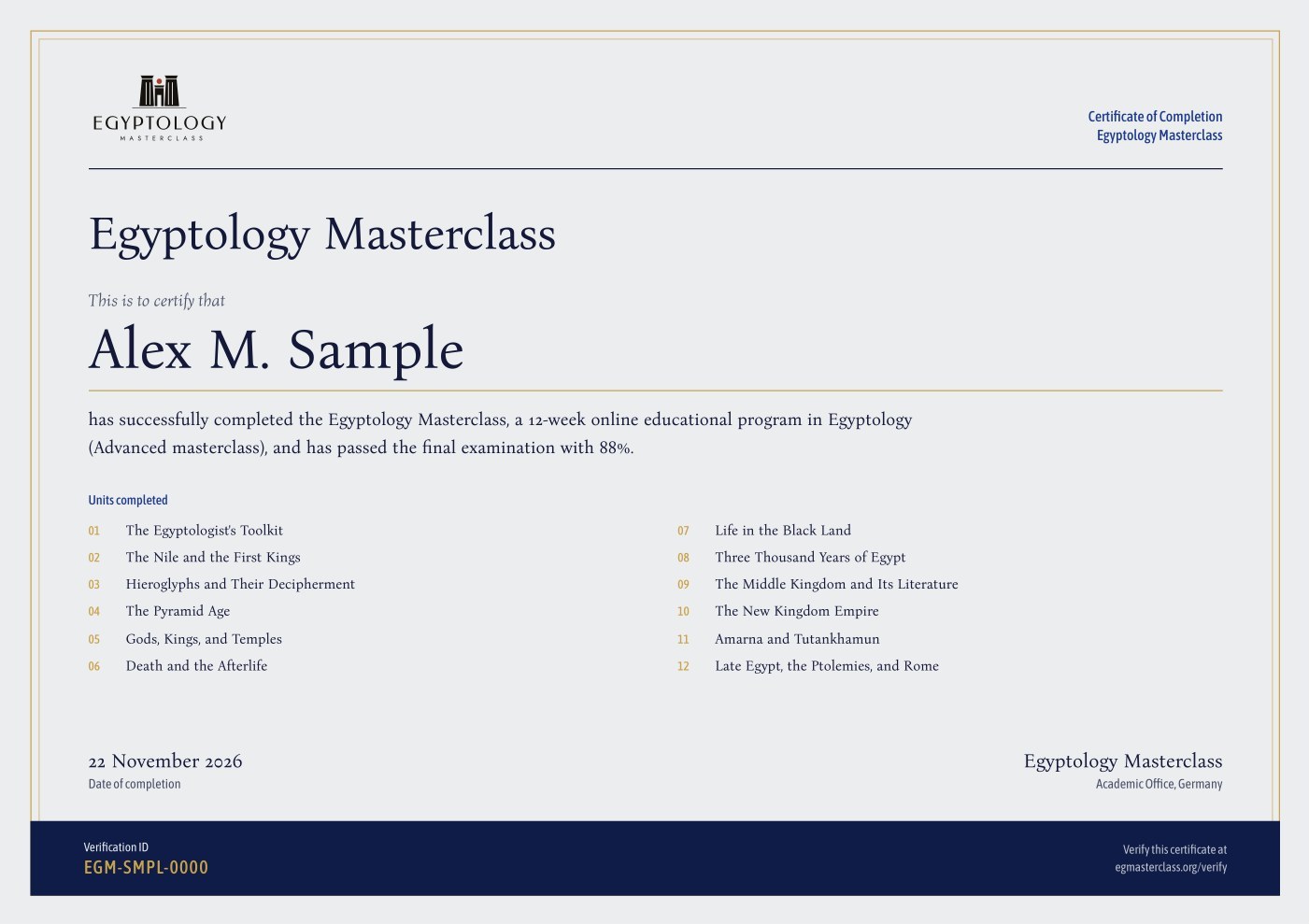
Sample certificate of completion of the Egyptology Masterclass

Certificate of completion

PDF, A4. Verification ID and a personal verification link.

Sample. A transcript with every quiz score is issued alongside.

Your certificate

Participants who pass the final exam receive an official certificate of completion. It states your name, the program, its duration, and the units you completed.

  • Certificate and transcript. The transcript lists your score in every unit quiz and in the final exam.
  • Verifiable. Both documents carry a verification ID that can be checked on this website.
  • Shareable. Your personal verification link shows your result to universities and employers.

Sample unit

Read one complete unit before you enrol, exactly as participants receive it: the full text with its sources, worked readings, figures, and research spotlight.

Unit 3, 16 pages

Hieroglyphs and Their Decipherment

How the hieroglyphic script combines sound signs, word signs, and classifiers, how a line of signs is read, and how Champollion read it in 1822 with the Rosetta Stone, a few royal names, and his knowledge of Coptic. By the end of the unit you read the cartouches of Ptolemy, Cleopatra, Ramesses, and Tutankhamun yourself.

The Rosetta Stone in the British Museum, with hieroglyphs, Demotic, and Greek visible

The Rosetta Stone

Granodiorite. One decree of 196 BC in hieroglyphs, Demotic, and Greek. Found at Rashid (Rosetta) in July 1799.

British Museum, London, EA 24

Photograph: Hans Hillewaert, CC BY-SA 4.0

Egyptology MasterclassUnit 3

Unit 3

Hieroglyphs and Their Decipherment

By the end of this unit, I should be able to answer these questions:

  1. Why did scholars before 1822 think hieroglyphs were symbols of ideas, and what showed that they also write sounds?
  2. What are uniliteral, biliteral, and triliteral signs, and what does a determinative add to a word?
  3. In which direction is a line of hieroglyphs read, and how can I tell from the signs themselves?
  4. What did the Greek text of the Rosetta Stone give Champollion, and what did his knowledge of Coptic give him?
  5. How did hieratic and Demotic develop from hieroglyphs, and what was each script used for?

How the hieroglyphic script combines sound signs, word signs, and classifiers, how a line of signs is read, and how Champollion read it in 1822 with the Rosetta Stone, a few royal names, and his knowledge of Coptic. By the end of the unit you read the cartouches of Ptolemy, Cleopatra, Ramesses, and Tutankhamun yourself.

How the script works, how a line is read, and how Champollion broke it in 1822

Academic community

Masterclass participants come from all over the world, and when you complete the program you stay part of a network that keeps you close to Egyptology.

Students of ancient Egypt in our community
2500+
Countries represented
90+
Schools and universities represented
750+

Nile-Connect

Our alumni program connects former participants across countries: for study advice, exchange about university applications, and shared projects.

Opportunities

Past participants hear from us about scholarships, competitions, summer schools, field schools, and other academic opportunities in Egyptology and archaeology.

A place in the field

The program shows you how research on ancient Egypt is done and where it happens, so that your next step, at school, at university, or beyond, is an informed one.

The academic community

Background: hypostyle hall of the Temple of Horus, Edfu, sandstone, Ptolemaic Period, built 237 to 57 BC. Photograph: Warren LeMay, CC0

Frequently asked questions

Who is this program for?

For high school students, university students, and lifelong learners. High school students use it to arrive at university knowing more than the first-year survey teaches, and as material for an Extended Essay, an EPQ, or a personal statement. University students in archaeology, history, classics, anthropology, or museum studies take it next to their degree. Lifelong learners, among them many who have walked through the Egyptian galleries of London, Berlin, Turin, or Cairo for years, use it to put what they know in order. The Foundation masterclass suits a first contact with the subject; the Advanced masterclass goes on to the Middle Kingdom, the New Kingdom empire, Amarna, and the Ptolemies.

What do I need to know before I start?

Nothing about Egypt and no ancient language. Unit 1 sets out the map of the Nile valley, the system of kingdoms and dynasties and how a date is produced, the kinds of evidence, and the conventions for writing Egyptian words in our alphabet. Unit 3 teaches how the script works from the first sign onwards. The little mathematics there is (the volume of a pyramid, a grain ration, the drift of a calendar) uses school arithmetic, and every step is shown.

How much time does a week take?

Most participants spend about four hours on a unit: reading the text and the sources in translation, working through the readings of objects and inscriptions, and taking the quiz. The further reading is optional and can take as long as you like. The units of the Advanced + Hieroglyphic Texts masterclass, which read Middle Egyptian texts in the original, take longer, because signs and words have to be learned.

Can I finish the program in less than 12 weeks?

Yes. A new unit is scheduled for every Monday, but once you have submitted the quiz of a unit you can ask for the next one ahead of schedule, from your dashboard or from the email we send you. The earliest moment is 24 hours after the previous unit was sent. We recommend the weekly rhythm, because the material needs time to settle, but the pace is your decision.

What happens if I fall behind or have to pause?

Nothing is lost. The next unit is only sent once you have submitted the quiz of the current one, so the program waits for you. You can pause for a week or for a term and continue at any time. There is no penalty and no deadline.

How does the final exam work?

After the last unit you sit the final exam online: 50 multiple-choice questions across all units of your masterclass, drawn individually for each participant, with a time limit of 60 minutes. It is open book. You pass with 70% correct answers. If you do not pass, you can try again after 3 days with new questions, up to 3 attempts in total.

All questions

Begin your 12 weeks in ancient Egypt

Background: the Great Hypostyle Hall at Karnak, Luxor, Nineteenth Dynasty. Photograph: MusikAnimal, CC BY-SA 4.0