

Royal and Temple Inscriptions
The five names of the king read in full for Thutmose III and Ramesses II, the protocol of a royal stela and the grammar of monumental texts, then the Kamose text, the opening of the Kadesh Poem, a complete offering scene from the Great Hypostyle Hall at Karnak, Piye's victory stela, and the names of Ptolemy V on the Rosetta Stone, each read in the original from a sign plate. The unit closes with how an epigrapher records a wall and where a reader goes on from here.
The texts of Units 13 to 15 were written on stone and papyrus for one owner, a steward, a courtier, a dead man. The texts of this unit were written for the whole country to see: the names of the king on a lintel, a stela set up at the gate of a temple, a battle poem carved on a pylon, and the thousands of scenes in which a king offers to a god. They are the texts a visitor meets on every wall in Egypt, and they are the texts Egyptologists read first when they work at a site. Their grammar is the Middle Egyptian of Units 13 and 14, kept alive as a learned language for fifteen centuries after people stopped speaking it, and their vocabulary is small and repetitive, which is why a reader who has come this far can read more of them than of any other kind of text. By the end you have read the full titulary of Ramesses II, the opening of the Kamose text and of the Kadesh Poem, a complete offering scene at Karnak, lines of Piye’s victory stela, and the names of Ptolemy V on the Rosetta Stone, and you know how the wall you read was recorded.
1 The five names of the king
Unit 5 gave the five names of the king in outline and Unit 13 read two cartouches of the Twelfth Dynasty. Here the whole set is read, because every royal text of this unit opens with it. Egyptologists call the set the royal titulary, and on a monument it runs in a fixed order: the Horus name, the Two Ladies name, the Golden Horus name, the throne name, and the birth name, each introduced by its own title sign. The set grew over a thousand years, and Figure 1 shows when each part first appears. The oldest part is the Horus name, written in the serekh, the rectangular frame drawn as the front of a palace, and it is as old as the kings of Dynasty 0. The First Dynasty added the title nswt-bỉty and the Two Ladies name. The cartouche appears at the end of the Third Dynasty and is used regularly from Sneferu onwards, and Djedefre, the son of Khufu, was the first to call himself Son of Re in front of his birth name. The Golden Horus name became a regular title in the Fourth Dynasty, and by the Middle Kingdom the five stood together as a fixed set. The kings of the next two thousand years, Libyan, Kushite, Persian, Macedonian, and Roman, took that set over, the Roman emperors often in a shortened form.
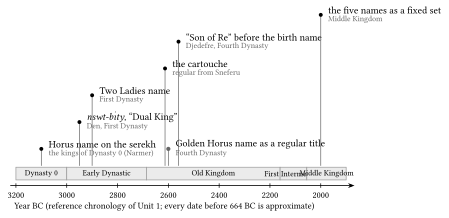
The title nswt-bỉty, the sedge and the bee, was translated “King of Upper and Lower Egypt” for a century, and Units 5 and 13 used that rendering. Many Egyptologists now prefer Dual King, because the two words are also used separately for two aspects of kingship and not for two halves of the map; the edition from which Section 4 reads uses “dual king”, and this unit follows it. Figures 2 and 3 give the five names of the two kings whose names a visitor sees most often, Thutmose III (reigned about 1479 to 1425 BC) and Ramesses II (reigned about 1279 to 1213 BC), in their standard writing.