

Life in the Black Land
Farming and the annual flood, households, law, and work, with the tomb builders' village of Deir el-Medina as one of the best documented communities of the ancient world. The unit reads the medieval flood record of Cairo against Pliny's scale of the Nilometer, divides a workman's grain ration among his family, follows a servant girl bought for silver and paid for in cloth and bronze, reads the will of Naunakhte and a head wound of the Edwin Smith papyrus, and follows the strike of year 29 of Ramesses III.
The kings, the gods, and the dead of the last five units left most of the monuments, but they were a small part of Egypt. Nearly everyone else farmed, baked, brewed, wove, carried water, or cut stone, and the record of those lives is thin and scattered: a painted harvest on a tomb wall, a letter written home by an anxious landowner, a court record scratched on a flake of limestone. One place is the exception. At Deir el-Medina, the village of the men who cut the royal tombs of the New Kingdom, the desert preserved the houses, the tombs, and tens of thousands of written scraps, so that the wages, the lawsuits, the sick days, and the quarrels of a few hundred families are known in more detail than those of any other community of the ancient world. This unit begins with the river that fed everyone, follows the grain from the field to the wage and the market, enters the house, and then spends most of its time in that village. The temple estates at the top of the economy belong to Unit 5, and the state the village served is the matter of Unit 8.
1 The river’s year
Egypt had almost no rain. What it had instead was a river that rose every summer, spread over the floodplain, and went down again, leaving behind wet soil and a thin layer of black silt. The Egyptians called the floodplain kmt, the Black Land, and the desert on either side dšrt, the Red Land, and the whole of their farming was arranged around the rise and fall of the water. The rise begins in June at Aswan, when the summer rains over the highlands of Ethiopia pour into the Blue Nile and the Atbara, the two rivers that bring the Nile most of its flood water, reaches its height at Thebes and Memphis in September, and is over by November. Figure 1 shows this year as a ring.
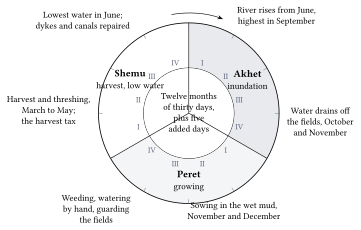
The Egyptians divided the year into three seasons of four months, named after the river. Akhet (ꜣḫt) was the inundation, Peret (prt), ’coming forth’, was the season in which the land emerged from the water and the crops grew, and Shemu (šmw) was the season of low water and harvest. The names belonged to the civil calendar of Unit 1, which drifted through the natural year, so that for most of Egyptian history the month called ’first of the inundation’ did not fall at the flood at all. The farmer worked by the river and not by the calendar.
The water was not left to come and go on its own. The floodplain was divided by low walls of packed earth, the dykes, into basins, some of them several kilometres across, and the flood was led into each basin through a cut in the dyke, held there for a month or more while the silt settled and the soil soaked, and then let out again downstream. This basin irrigation needed nothing more than earth, labour, and agreement between neighbours, and it lasted until the dams of the nineteenth and twentieth centuries ended the flood. Sowing began in November, as soon as the mud could be walked on, with the seed scattered by hand and trodden in by sheep or pigs. The two grains were emmer (Triticum dicoccum), a hulled wheat whose grains stay inside their husks when threshed, and barley (Hordeum vulgare); flax (Linum usitatissimum) gave linen and oil, and gardens grew onions, lettuce, lentils, dates, figs, and grapes. The harvest came between March and May. The grain was cut with flint-toothed sickles, threshed under the hooves of cattle, which trod the grain out of the ears, and winnowed in the wind, which means that it was tossed into the air so that the wind carried the light chaff away. Figure 2 shows a workman of Deir el-Medina and his wife at this work, painted in the place where they expected to do it forever.
The state was interested in the harvest before it was cut. Scribes measured the fields with knotted ropes, recorded who held the land and how good it was, and assessed the harvest tax (šmw, the same word as the season) in grain. The largest surviving register of this kind, the Wilbour Papyrus in the Brooklyn Museum, records the assessment in year 4 of Ramesses V (reigned about 1147 to 1143 BC) of several thousand plots along some 140 km of Middle Egypt, most of them temple land worked by tenants. How much a field could yield depended on how well the flood had covered it, so the state measured the flood as well.