

Late Egypt, the Ptolemies, and Rome
The thousand years that museum labels compress into 'Late Period': the divided Egypt of the Libyan chiefs and the priests of Amun, the Kushite and Saite kings who restored the old forms, two Persian occupations, Alexander, the Ptolemies as pharaohs and Greek kings at once, and Egypt as the granary of Rome until the temples closed. The unit reads the reused coffins of a queen, the clauses of the Rosetta decree, and the ice cores that date the failed floods behind the Ptolemaic revolts.
The centuries that a museum label lumps together as “late” cover more time than the Old and Middle Kingdoms together. Between the death of Ramesses XI, about 1069 BC, and the closing of the last temple of Isis at Philae in the sixth century AD, Egypt was ruled by Libyan chiefs, Kushite kings from the south, the Persian empire twice over, the Macedonian house of the Ptolemies, and the emperors of Rome. This unit takes them one at a time and asks of each what the new rulers took from Egyptian kingship, what they kept of their own, and what the country itself did while they ruled. Unit 8 told these centuries in outline; here the evidence is read up close, from a queen’s secondhand coffin to the sulfur of an Alaskan volcano in the ice of Greenland. The decipherment of the Rosetta Stone belongs to Unit 3, the funerary texts of these centuries to Unit 6, and reading the inscriptions of these centuries in the Egyptian language lies beyond this unit.
1 The Third Intermediate Period
When Ramesses XI died, the throne did not pass to a son. Smendes (reigned about 1069 to 1043 BC), a governor in the Delta, took the throne at Tanis and founded the Twenty-first Dynasty, and at the same time the high priests of Amun at Thebes, beginning with Herihor (high priest in the last decade of Ramesses XI) and Pinedjem I (high priest from about 1070 to 1032 BC), governed Upper Egypt in the name of the god. The two houses were not at war but intermarried, Thebes dated its papyri by the regnal years of the Tanite king, and Pinedjem I at times wrote his own name in a cartouche without anyone at Tanis objecting. Egypt had become a country with two capitals and one royal family, and the arrangement held for a century.
The second house was Libyan. The Libyan peoples whom Ramesses III had defeated and then settled in Egypt as soldiers, above all the Meshwesh, called the Ma for short in Egyptian texts, had become by the tenth century BC a hereditary military aristocracy of the Delta, organized in tribes under men who carried the title “great chief of the Ma”. In 945 BC one of them, Sheshonq I (reigned about 945 to 924 BC), became king and founded the Twenty-second Dynasty. He did everything an Egyptian king did. He took a full titulary and built a gateway at Karnak that records his campaign into Palestine; he is probably the Shishak of the Bible, who took the treasures of the temple at Jerusalem. His tomb has never been found and probably lay at Tanis with those of his successors. What his family did not do was give up the Libyan way of sharing power. Sons and brothers were installed as high priests, generals, and chiefs in the Delta towns, each with his own court, and within a century the descendants of the men so appointed were writing their own names in cartouches, which is to say that they were calling themselves kings. By about 730 BC the Delta and Middle Egypt had four men calling themselves king at once, at Tanis, Leontopolis, Herakleopolis, and Hermopolis, together with a dozen great chiefs, and a fifth ruler, Tefnakht of Sais (ruled about 727 to 720 BC), was taking over the chiefdoms of the western Delta one by one. Figure 1 shows this Egypt.
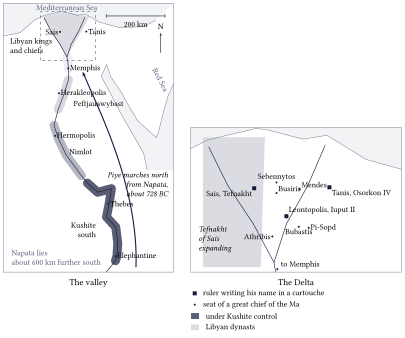
Thebes stayed outside this competition because of an office that the Libyan kings had turned into an instrument of rule. The God’s Wife of Amun was a priestess at the head of the Theban clergy, by this time always a king’s daughter who stayed unmarried and adopted her successor, so that whoever placed his daughter in the office controlled the richest temple in Egypt without a battle. The Libyan kings used it first. Then, about 750 BC, the Kushite king Kashta (reigned about 760 to 747 BC), whose capital Napata lay far to the south in Nubia, had his daughter Amenirdis adopted as the heir of the God’s Wife, and Thebes passed into the hands of Napata as quietly as a will is read. Section 2 follows what came of that.
1.1 An economy of scarcity
Behind the politics lies an economy that had lost the sources of its wealth. The gold of Nubia stopped arriving when Nubia went its own way at the end of the Twentieth Dynasty, the cedar of Lebanon came only when a Delta ruler could afford to send for it, and the tribute of an empire was a memory. The clearest sign of what this meant is in the cemeteries of Thebes. The trials of tomb robbers under Ramesses IX and Ramesses XI, which Unit 6 described, had shown gangs stripping the gold from royal and private burials with the silent agreement of officials; under the Twenty-first Dynasty the authorities stopped prosecuting and started organizing. The high priests of Amun had the royal mummies of the New Kingdom collected from their tombs, rewrapped, labelled with dockets, short notes in ink on the wrappings that record the date of the work, and hidden in two caches, one of them the tomb now numbered TT320 at Deir el-Bahari, where some fifty mummies of kings, queens, and priests were found in 1881. The dockets present this as piety, and it was also an inventory. The gold and the inlays had gone from the royal coffins before they were reburied, and the coffins themselves were the plainest wooden shells.