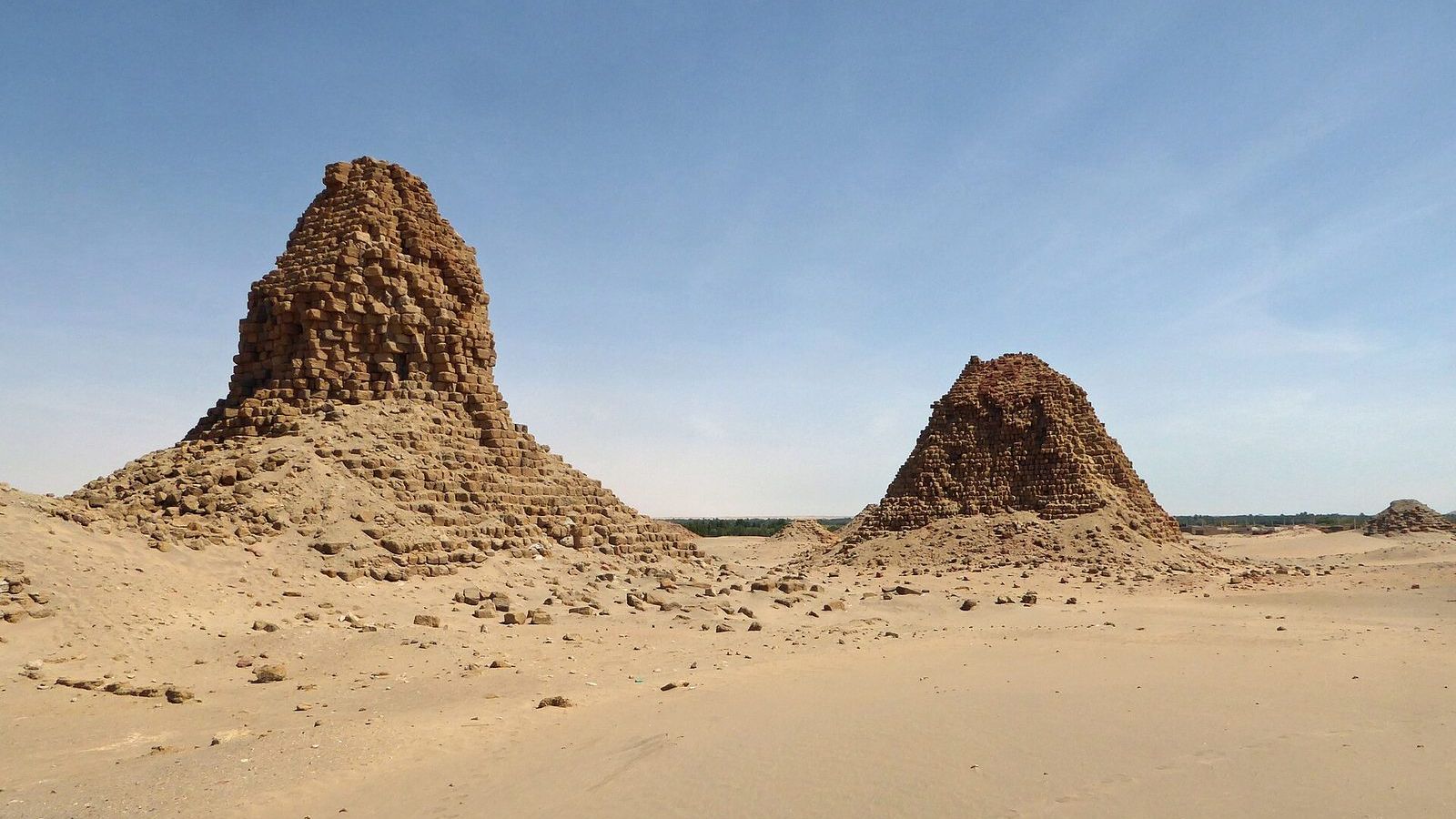
 Image: Hans Birger Nilsen (CC BY-SA 2.0); the royal pyramids of Nuri, Sudan
The Kushite pharaohs
In the eighth century BC Egypt was not one country. The kings of the Twenty-second and Twenty-third Dynasties, descendants of Libyan settlers, ruled from Tanis and Leontopolis in the Delta; a prince of Sais, Tefnakht, was building a power of his own in the west; Thebes was governed by the priests of Amun and by a God's Wife of Amun, a royal daughter who held the office for life; and a dozen chiefs held the towns of Middle Egypt. Into this came an army from the south, led by a king who claimed Egypt for the god Amun, and whose own account of the campaign is one of the longest royal inscriptions ever found.
Napata
The kingdom of Kush had its capital at Napata, near the fourth cataract of the Nile, below a flat-topped sandstone mountain called Gebel Barkal that the Egyptians of the New Kingdom had declared a southern home of Amun. Egypt had ruled Nubia for five hundred years, built temples there, and trained its elite in Egyptian ways; when the New Kingdom collapsed, around 1069 BC, Nubia went its own way, and by the ninth century a line of local rulers at Napata had become kings. They worshipped Amun, wrote in Egyptian, and buried themselves at el-Kurru under mounds that became pyramids. Their names are Egyptian or Kushite: Alara, Kashta, Piye.
Kashta, in the middle of the eighth century BC, extended his rule north to Elephantine and had his daughter Amenirdis adopted as the next God's Wife of Amun at Thebes, which gave Kush a hold on Upper Egypt without a battle. His son Piye, whose reign the chronology of this program dates to about 747 to 716 BC, went further.
Piye's stela
In about 728 BC Tefnakht of Sais marched south with the allied chiefs of the Delta and besieged Heracleopolis in Middle Egypt, whose ruler was loyal to Piye. Piye sent an army, then came himself, celebrating the New Year festival at Thebes on the way. He took Hermopolis after a siege, received the submission of its king Nimlot, who came out with his wife and daughters, and marched on Memphis, which he took by storm from the harbour side. At Heliopolis he worshipped Re. The chiefs of the Delta came one by one to submit; Tefnakht sent his oath from a distance. Piye then loaded his ships with their tribute and went home to Napata. He did not stay to rule Egypt.
His account of all this, 159 lines of hieroglyphs on a granite stela set up in the temple of Amun at Gebel Barkal and now in the Egyptian Museum in Cairo, is written in good Middle Egyptian, the classical language of a thousand years before, and is full of detail that no other royal inscription offers: the tactical advice Piye gave his generals, his reproach to Nimlot for letting his horses starve during the siege, which angered him more than the rebellion, and his refusal to receive the Delta chiefs in person because they had eaten fish and were unclean. He presents himself as the pious servant of Amun restoring order to a land that had fallen into disorder, and the Egyptian ruler Tefnakht as the rebel.
A century of rule
Piye's successor Shabaqo came north again around 716 BC, defeated Tefnakht's successor Bakenranef, and this time stayed. From then until the 660s the kings of Kush ruled Egypt from Memphis and Thebes as the Twenty-fifth Dynasty of the Egyptian king lists: Shabaqo, Shebitqo, Taharqo, and Tanutamani. Taharqo, who reigned from 690 to 664 BC, was the greatest builder of them: a colonnade and a kiosk at Karnak, temples at Kawa and Sanam in Nubia, restorations throughout Egypt, and at Nuri, across the river from Gebel Barkal, the largest pyramid ever built in Sudan, which began the royal cemetery that still stands there.
The Kushite kings were deliberate archaizers. They revived the pyramid as a royal tomb a thousand years after the last Egyptian king had built one. They had the Pyramid Texts of the Old Kingdom copied into their burial chambers. Their sculptors went back to the statues of the Old and Middle Kingdoms for their models, and the Kushite royal portrait, with its broad face, its double uraeus, and its cap crown, is immediately recognizable. Shabaqo had a theological text of Memphis, which he said he had found on a worm-eaten papyrus, carved on a block of basalt so that it would not be lost; the Shabaqo Stone is now in the British Museum, worn flat in the centre from later use as a millstone. The Kushites did not see themselves as foreigners ruling Egypt. They saw themselves as the Egyptians who still did things properly.
Assyria
The dynasty ended under pressure from the north. The Assyrian empire under Esarhaddon invaded Egypt in 671 BC and took Memphis, capturing Taharqo's family; Taharqo retook it when the Assyrians left. Assurbanipal invaded again in 667 and drove Taharqo south. Tanutamani, his successor, came north once more in 664 and retook Memphis, and in response Assurbanipal's army marched up the river and sacked Thebes, in 664 or 663 BC, carrying off its treasures and two obelisks. The sack of Thebes was remembered as far away as Judah, where the prophet Nahum used it as an example of what would happen to Nineveh.
The Assyrians could not hold Egypt either. Their client in Sais, Psamtek I, made himself king of the whole country within a decade, and Egyptian chronology dates the Twenty-sixth Dynasty, and the start of the exact dates that this program uses, from his accession in 664 BC. The Kushite kings retreated to Napata and ruled there, and later from Meroe further south, for another thousand years, building pyramids and writing Egyptian until they developed a script of their own. Their kingdom outlasted pharaonic Egypt.
Where this appears in the masterclass
Unit 12 of the Egyptology Masterclass covers the Twenty-fifth Dynasty in its account of the Third Intermediate Period and reads Piye's stela on the siege of Memphis in translation as a worked case, with the archaism of the Kushites and the Saites as a key idea. Unit 8 places the dynasty and the sack of Thebes in the long narrative, and Unit 16 reads five statements of the stela in the original as an example of Kushite Middle Egyptian.