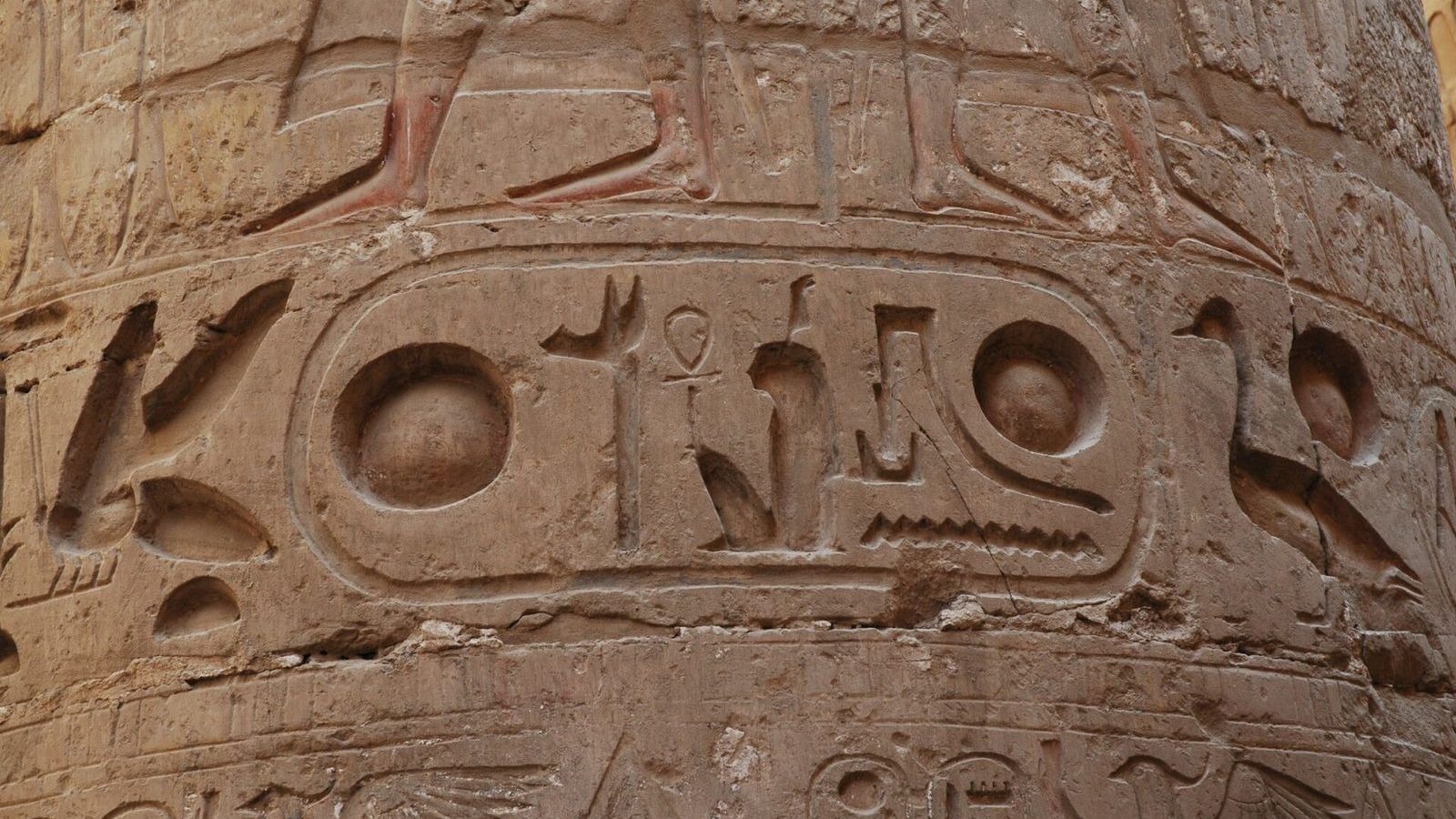
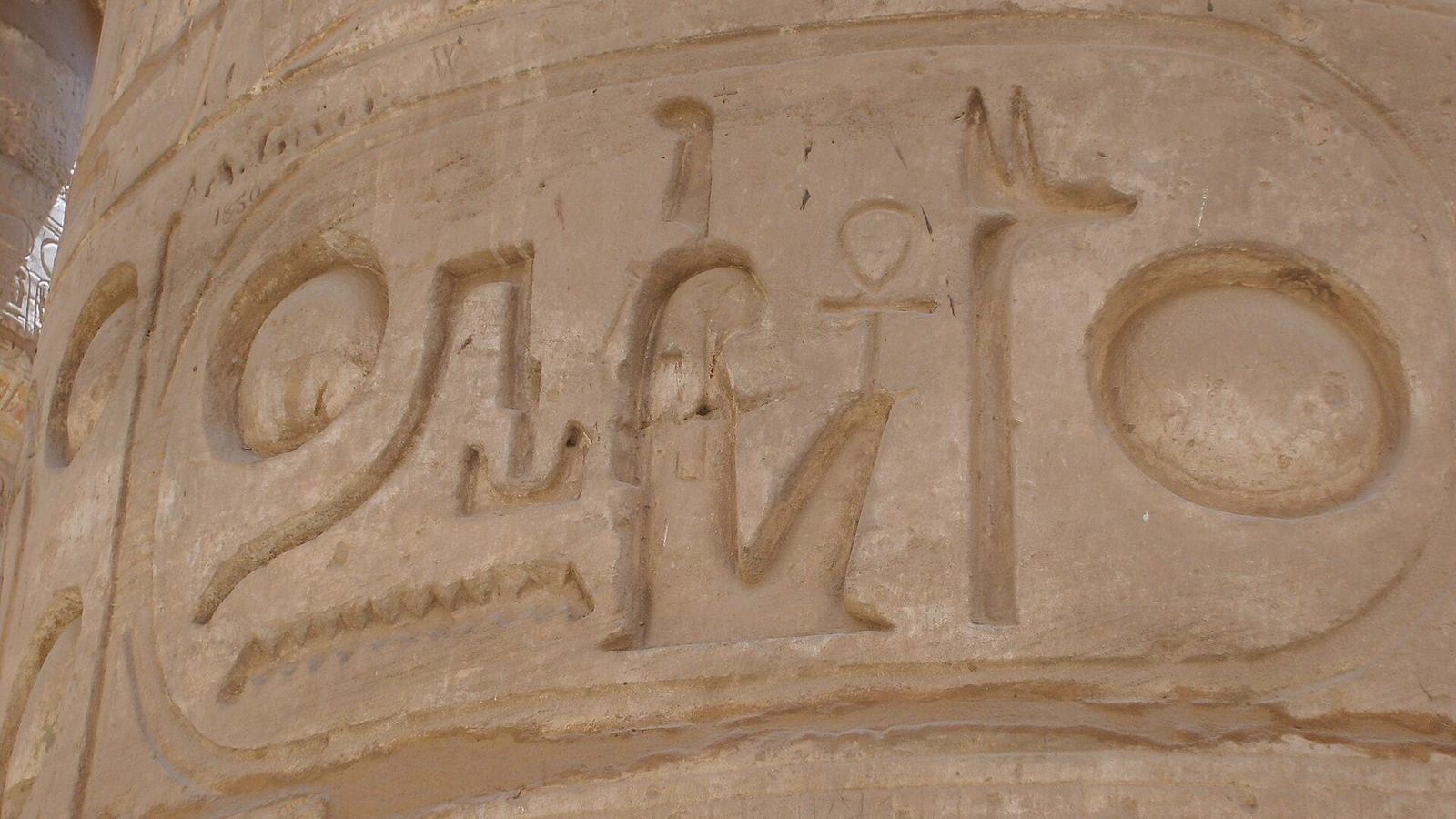
 Image: Dapaan (CC BY-SA 3.0); cartouches of Ramesses II
The five names of a pharaoh
On the walls of Karnak, at the head of nearly every inscription, stands a row of five names. Visitors who have learnt to read a cartouche find two of them, the ones inside the ovals, and skip the rest. The rest are worth the trouble. The five names together, which Egyptologists call the titulary, are a statement of what the Egyptians thought a king was, and the order in which they were added over the centuries is a short history of kingship.
The Horus name
The oldest name is the Horus name. It is written inside a rectangle called a serekh, whose lower part is a drawing of the panelled facade of a palace, with a falcon perched on top. The falcon is Horus, the god of kingship, and the name inside declares the king to be a form of that god on earth. The kings of Dynasty 0 and the First Dynasty, about 3100 BC, are known almost only by their Horus names, Narmer, Aha, Djer, and Den among them, because that was the name they wrote on jars, labels, and seals. Narmer's name on his palette is written in a serekh between two heads of the goddess Hathor. In later periods the Horus name became a programme: Thutmose III was Horus Strong Bull Arising in Thebes, and Ramesses II was Horus Strong Bull Beloved of Maat.
The Two Ladies name
The second name is introduced by two goddesses side by side: Nekhbet the vulture of Upper Egypt and Wadjet the cobra of Lower Egypt, each on a basket. The Egyptians called them the Two Ladies, nebty, and the name that follows says that the king rules both halves of the country. It appears in the First Dynasty, under the kings who had just made the two halves one, and it stayed in use for three thousand years. Thutmose III's Two Ladies name was Enduring of Kingship like Re in Heaven; Ramesses II's was Protector of Egypt who Curbs the Foreign Lands.
The Golden Horus name
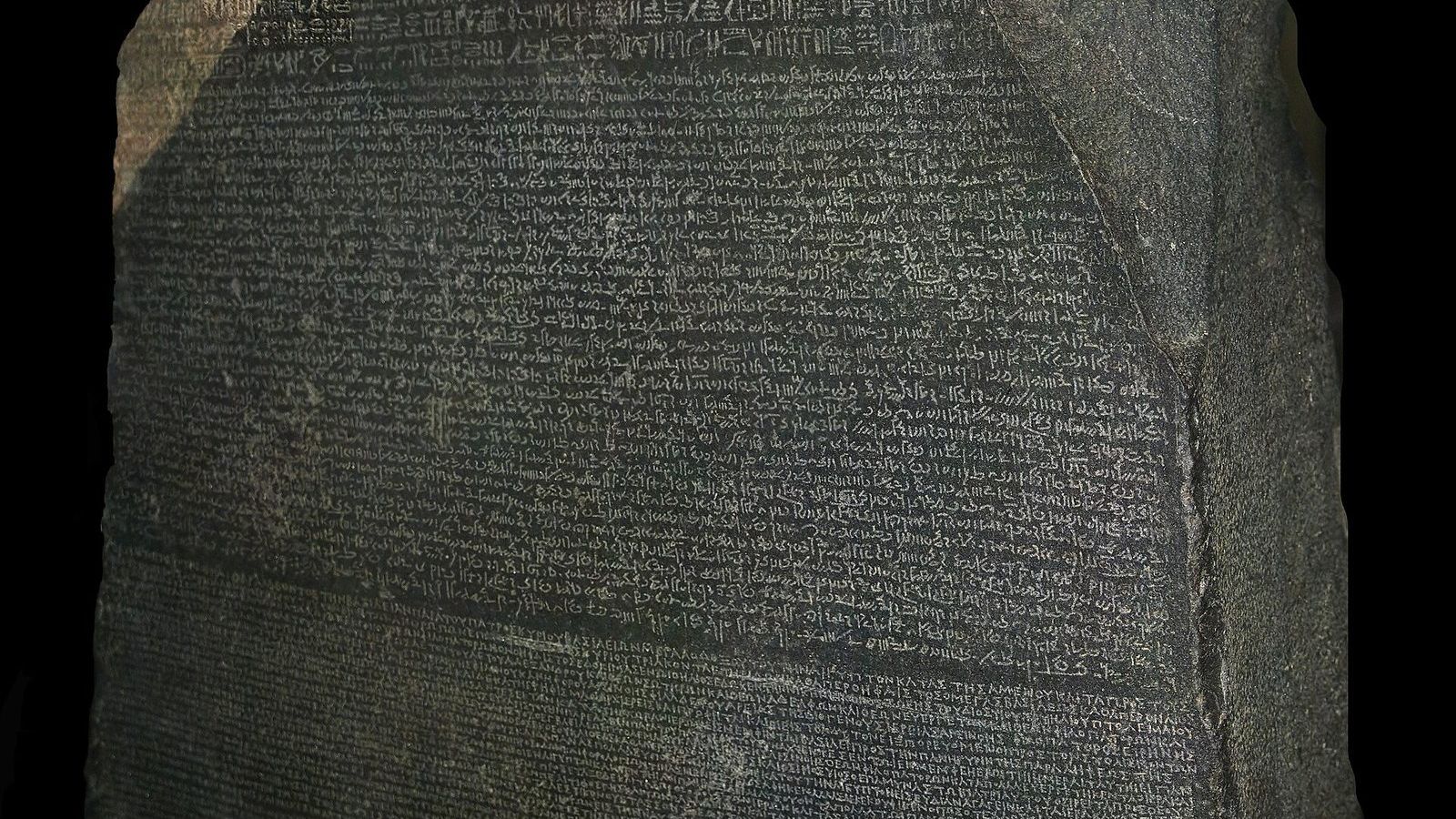
The third name is written with a falcon perched on the sign for gold, a collar of beads. Its meaning was argued about by the Egyptians themselves. The Ptolemaic priests who wrote the Greek version of the Rosetta Stone translated it as the one who is superior to his enemies, taking gold as a sign of triumph, and the falcon on gold is sometimes read as Horus victorious over Seth, the god of the city of Ombos whose name was written with the gold sign. The name became standard in the Fourth Dynasty. Thutmose III was Golden Horus Holy of Appearances, Mighty of Strength; Ramesses II was Golden Horus Rich in Years, Great in Victories.
The throne name
The fourth name is the first of the two inside a cartouche, and it is introduced by a sedge plant and a bee, which read He of the Sedge and the Bee, the plants and insect that stood for Upper and Lower Egypt. It is the name the king took at his accession, and it almost always contains the name of the sun god Re, written first out of respect and read last. Menkheperre, the throne name of Thutmose III, means the form of Re is established; Usermaatre, the throne name of Ramesses II, means powerful is the order of Re. The throne name was the king's official name in documents and the one by which he was dated. The sedge and bee title goes back to the First Dynasty; the cartouche around the name appears under Sneferu at the start of the Fourth.
The birth name
The fifth name is the one the king was given as a child, and it is introduced by a duck and a sun disc, which read Son of Re. It is the name we use: Thutmose, Amenhotep, Ramesses, Tutankhamun. The title Son of Re was added under the Fourth Dynasty, when the kings of Giza turned towards the sun cult, and it marks a change in what a king was: no longer only Horus, the god himself, but the son of the greater god who rules the sky. It is the birth name, and not the throne name, that is usually followed by the epithet beloved of a god, as in Ramesses Beloved of Amun.
How the set grew
Put together, the history runs like this. First Dynasty: Horus name and Two Ladies name, and the sedge and bee title. Fourth Dynasty: the Golden Horus name, the cartouche, and the Son of Re title. By the Middle Kingdom, about 2000 BC, the five-part titulary was fixed, and every king from then to the Roman emperors received one at his accession. The emperor Augustus has a Horus name and a Two Ladies name on the temple walls of Dendera and Philae, invented for him by Egyptian priests who had never seen him.
The titulary was composed with care. A new king's names were a manifesto, announcing the themes of the reign, and they were sometimes changed when the reign changed course. Hatshepsut, who began as regent for Thutmose III, took a full titulary with masculine grammar when she became king. Amenhotep IV changed his birth name to Akhenaten in his fifth year, when he turned to the Aten, and changed his Horus name and his Golden Horus name with it.
Finding them on a wall
On a stela or a temple wall the full titulary is usually written as one line, in the order above, after the date. Look for the serekh with the falcon on top; the two goddesses on their baskets; the falcon on the gold collar; the sedge and the bee followed by a cartouche; and the duck and the sun followed by a second cartouche. Each introductory sign is followed by its name. Once you have found the sequence once, you will see it everywhere, from the pylons of Karnak to the base of an obelisk in Rome.
Unit 16 of the Egyptology Masterclass, Royal and Temple Inscriptions, reads the full titulary of Thutmose III and Ramesses II from a plate as its first worked case, and its interactive lets you build a titulary from the elements. Unit 5 introduces the five names in outline in its section on the king as the one priest of Egypt.