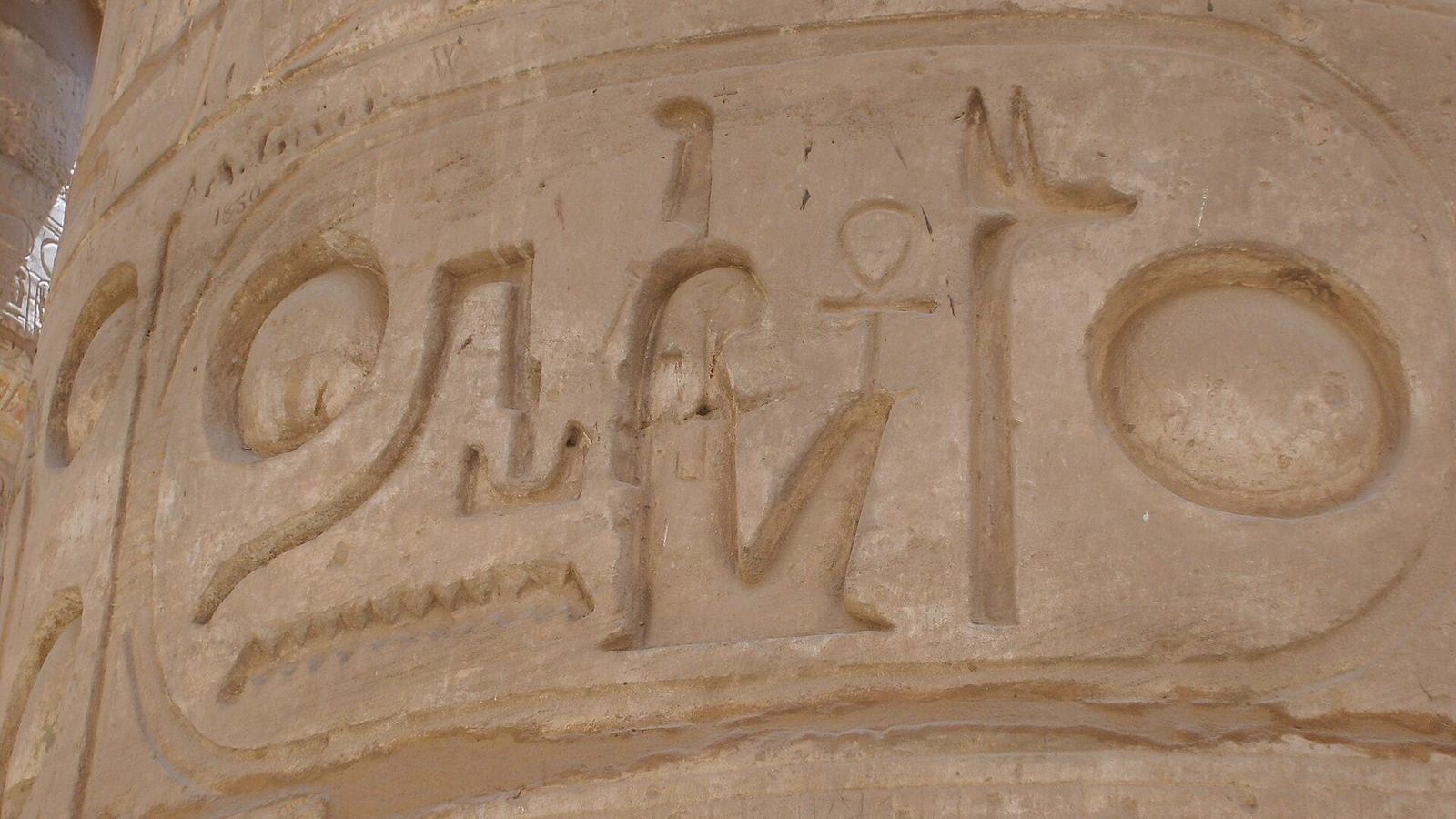
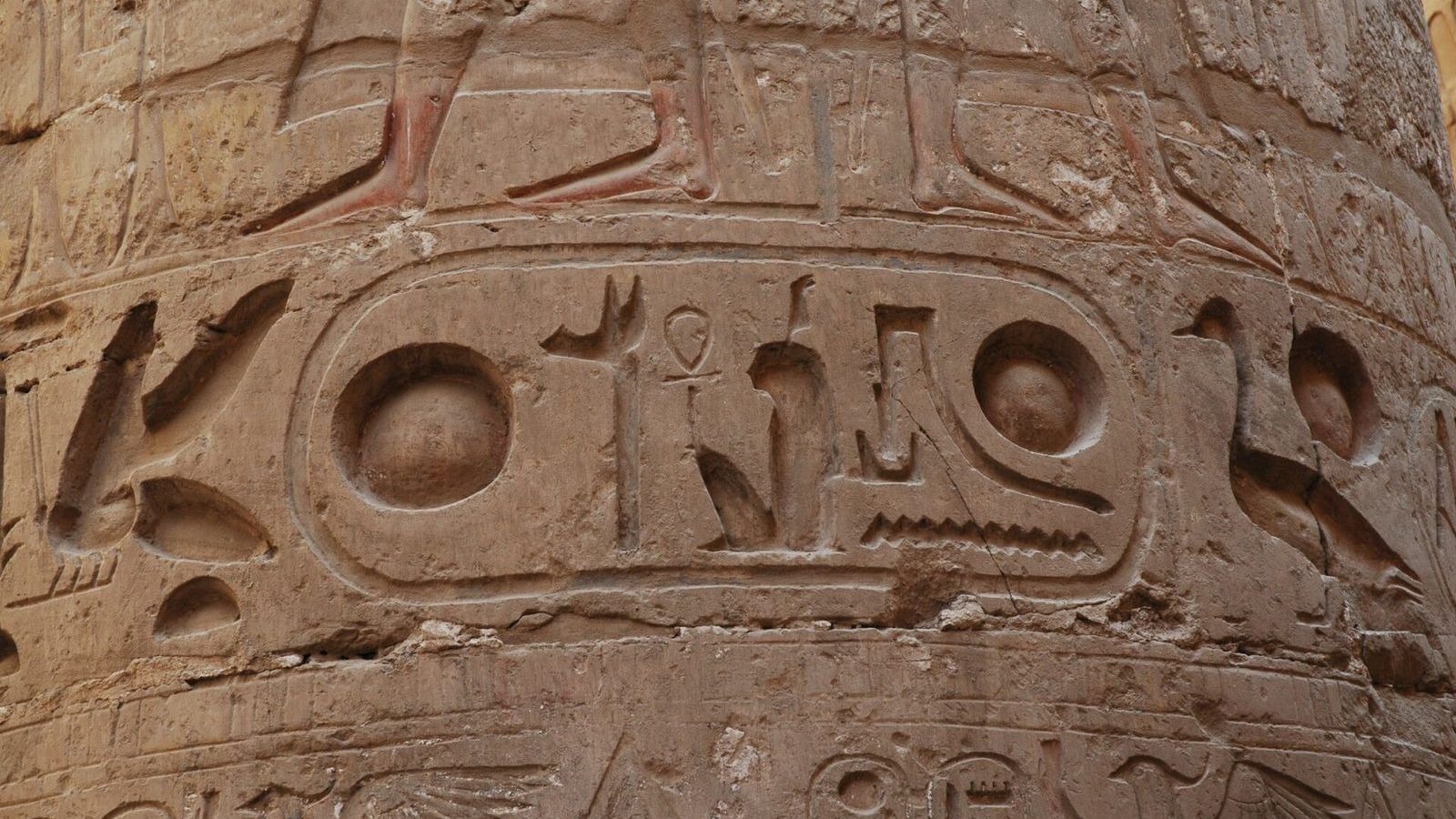
 Image: Francesco Gasparetti (CC BY 2.0); a cartouche of Ramesses II at Karnak
How to read a cartouche in a museum
A cartouche is an oval ring with a flat bar at one end. The Egyptians drew it around the two most important of a king's five names, and from the Fourth Dynasty to the Roman emperors every royal name on a statue, a stela, a temple wall, or a scarab sits inside one. That makes cartouches the easiest place to start reading hieroglyphs. The signs inside them come from a small set, the names repeat, and the museum label usually tells you whose object you are looking at, so you can check your reading.
Three rules before the signs
First, direction. Hieroglyphs can be written from left to right or from right to left, and the signs tell you which: people, animals, and birds face the beginning of the line. If the owl looks to the left, start reading at the left. Inside a cartouche the signs are read in the same direction as the text around it, and within the oval they are read from the end opposite the bar.
Second, grouping. Signs are arranged in neat blocks to fill the space, with a tall sign standing beside two small ones stacked on top of each other. Read the upper sign of a stack before the lower one, and read each block before moving on to the next.
Third, respect. When the name of a god forms part of a king's name, the god's sign is written first, at the front of the cartouche, even though it is pronounced last. Egyptologists call this honorific transposition. The name Tutankhamun is written Amun-tut-ankh and read Tut-ankh-Amun. Almost every royal name contains a god, usually Re or Amun, so this rule applies almost every time.
The ten signs
These signs account for most of the New Kingdom cartouches you will meet. Their Gardiner codes are given for looking them up.
- The sun disc, a circle with a dot (N5): the god Re. It appears in nearly every throne name and is read last.
- The scarab beetle (L1): kheper, meaning to come into being.
- The basket with no handle (V30): neb, lord or all.
- The draughts board with its pieces, a rectangle with a row of marks (Y5): men, established.
- The seated goddess with a feather on her head, or the feather alone (C10, H6): Maat, right order.
- Three fox skins tied together (F31): mes, born.
- The folded cloth, a tall sign like a hook (S29): s.
- The reed leaf (M17): i, and the water line, a zigzag (N35): n. Together with the draughts board they write Amun: reed, draughts board, water.
- The looped cross (S34): ankh, life.
- The ibis on a standard (G26): the god Thoth; and the offering mat with a loaf on it (R4): hetep, content or at peace.
Worked readings
Thutmose III, throne name. Inside the cartouche you see the sun disc, then the draughts board, then the scarab. Apply the respect rule: the sun disc is Re and comes last. Draughts board is men, scarab is kheper. The name is Men-kheper-Re, which means the form of Re is established. Thutmose's birth name, in the second cartouche, is the ibis of Thoth followed by the fox skins and the folded cloth: Thoth-mes, born of Thoth, which Greek writers turned into Thutmose. The name Menkheperre is one of the commonest cartouches in any museum, because it was used as a lucky name on scarabs for a thousand years after the king's death.
Amenhotep III, throne name. Sun disc, basket, feather or seated goddess. Re last: Neb-maat-Re, Re is the lord of order. Birth name: reed, draughts board, water, then the offering mat: Amun-hetep, Amun is content. The Greeks called him Amenophis.
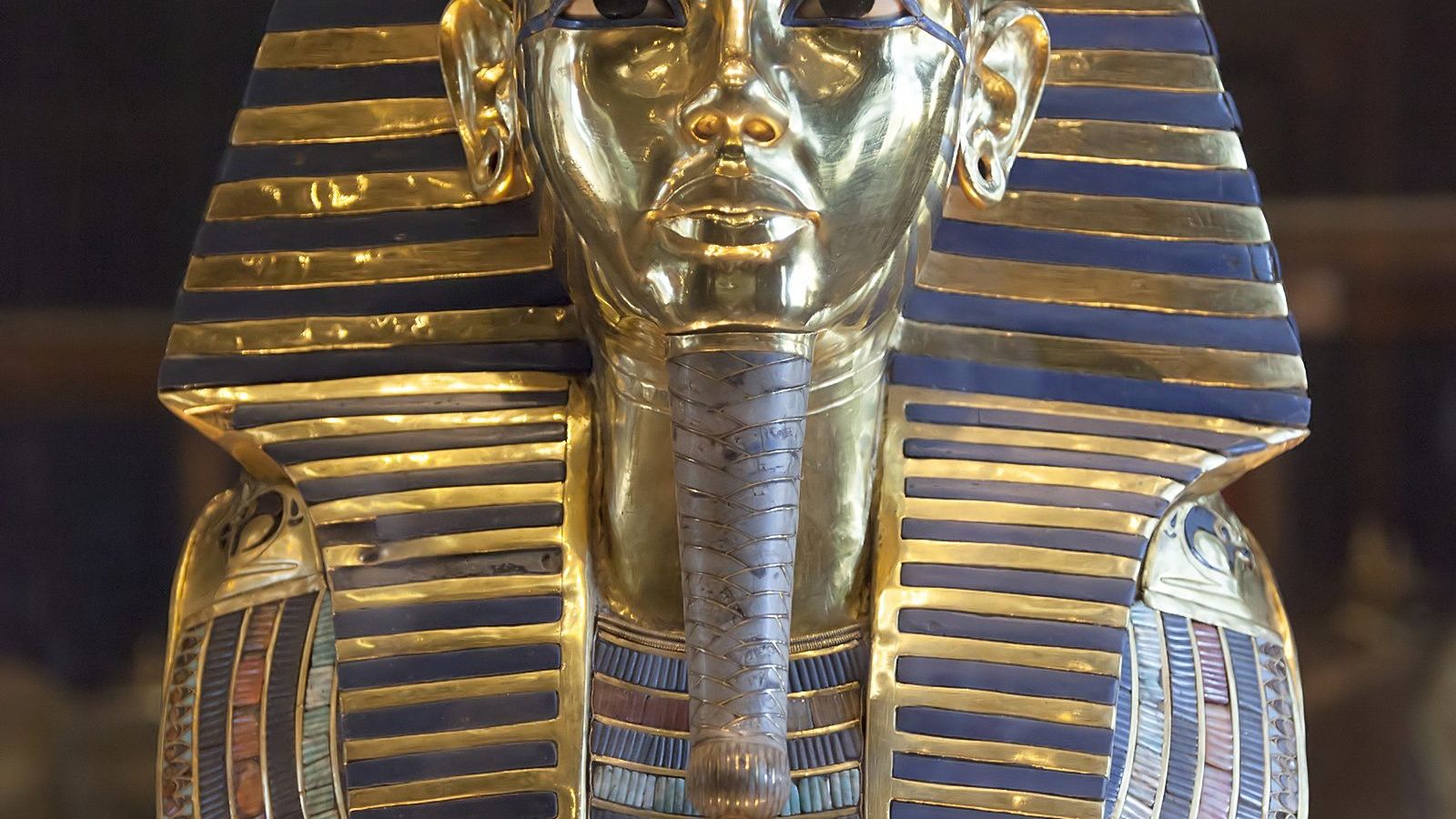
Tutankhamun, throne name. Sun disc, basket, scarab with three short strokes beneath it. The strokes are the plural marker. Neb-kheperu-Re, Re is lord of forms. Birth name: reed, draughts board, water for Amun, written first for respect, then a loaf, a chick, a loaf for tut, image, then the ankh: Tut-ankh-Amun, the living image of Amun. On the objects from his tomb the name is often followed by a short title, ruler of southern Heliopolis, which means Thebes.
Ramesses II, throne name. Sun disc, the sceptre with an animal head (user, powerful), the seated goddess Maat, then the sun disc again, the adze (setep, chosen), and the water line. User-maat-Re setep-en-Re, powerful is the order of Re, chosen of Re. The Greeks compressed this to Ozymandias, which is the name Shelley used. Birth name: sun disc, fox skins, folded cloth, and often a second folded cloth or a sedge and chick for su, then reed, draughts board, water, and a hoe for mer: Ra-mes-su mery-Amun, Re has borne him, beloved of Amun. The god Amun is written first in the second part, for respect, and read last.
What to do when it does not work
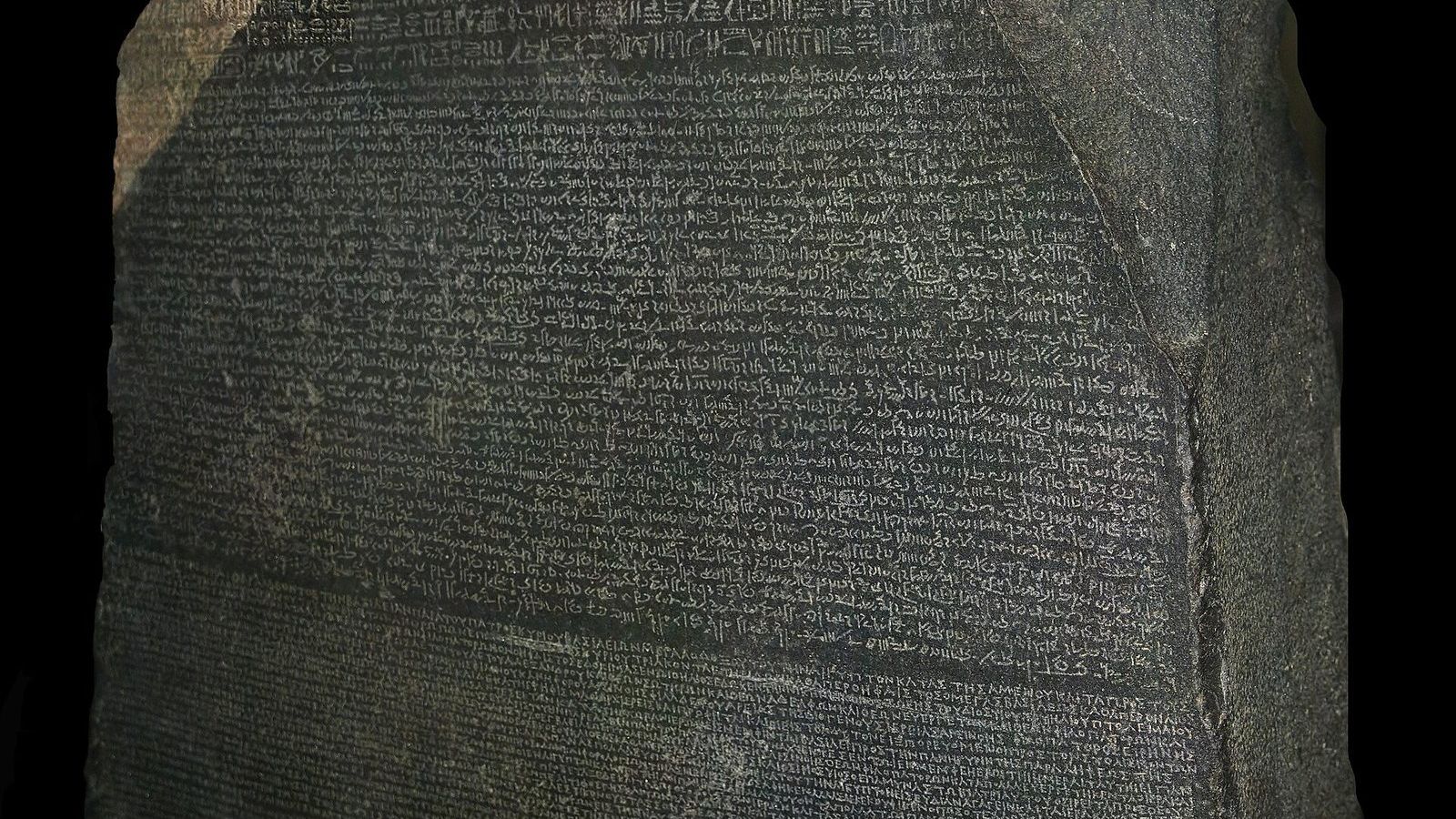
Several things can go wrong, and all of them are informative. The cartouche may belong to a king whose name you do not know; the label will tell you, and you can work backwards from the label to the signs. The name may be written with variant signs: the sun god's name can be written with the disc alone or with a falcon-headed figure, and mes is sometimes written with the fox skins and sometimes with a different sign. A late cartouche of a Ptolemy or a Roman emperor spells a Greek or Latin name alphabetically, with a different and longer set of signs, which is how Champollion began. And a cartouche on a statue may have been recut: Ramesses II put his name on hundreds of older statues, and the traces of the earlier name are often visible under his.
The habit to form is to read the signs before reading the label, and then to compare. After a few visits the ten signs become automatic, and the museum changes: every case has names in it.
Unit 3 of the Egyptology Masterclass, the sample unit, teaches the sign functions and reads Ptolemy, Cleopatra, Ramesses, and Tutankhamun with plates. Unit 16 reads the full titulary of five names for Thutmose III and Ramesses II, including the three names that stand outside the cartouches.