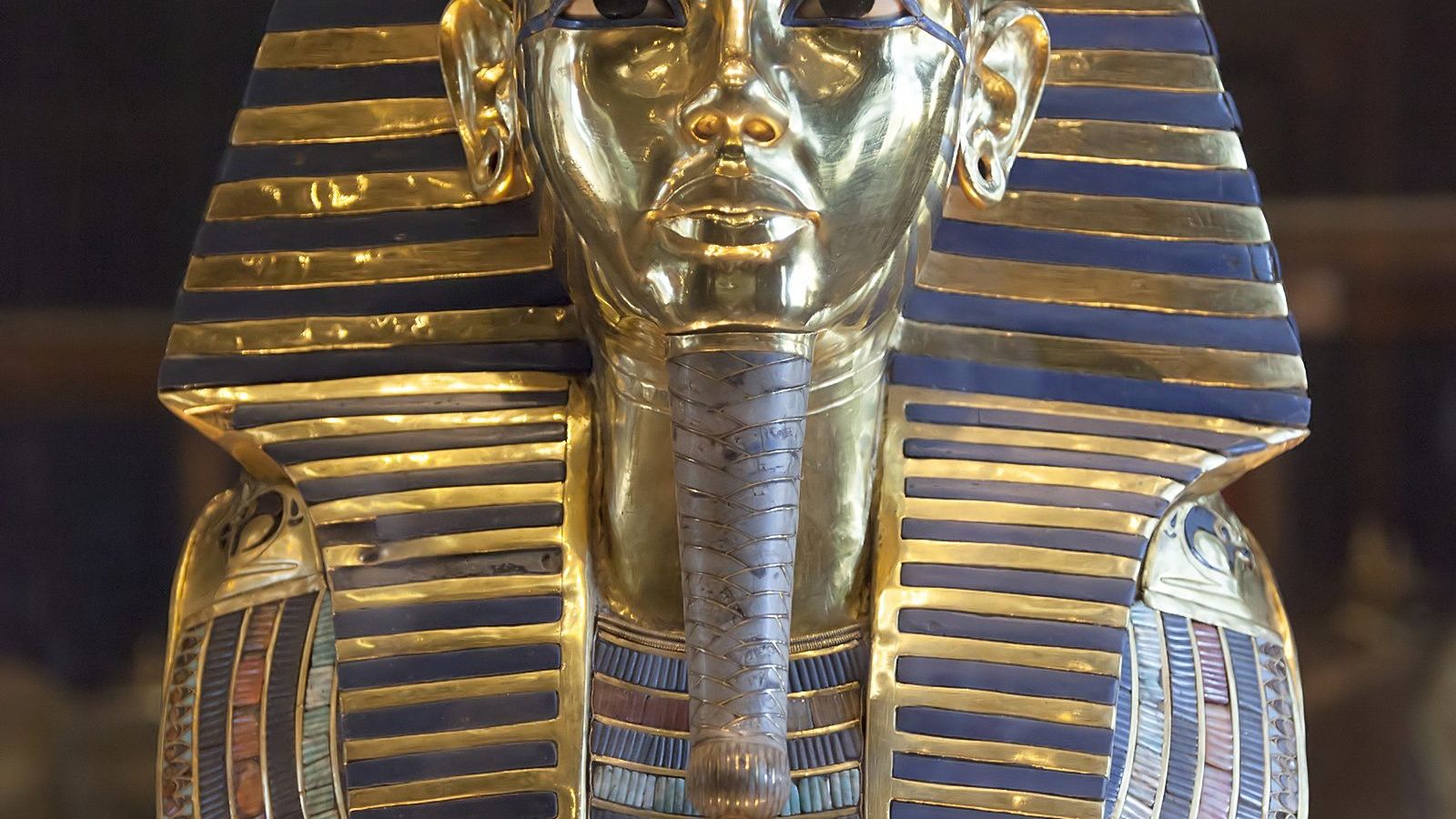
 Image: Roland Unger (public domain); the gold mask of Tutankhamun, Egyptian Museum, Cairo
Tutankhamun's tomb by the numbers
The story of the tomb of Tutankhamun is usually told as an adventure. It can also be told as a set of numbers, and the numbers are more surprising than the adventure. They come from the excavation records of Howard Carter, which the Griffith Institute in Oxford has published in full online, card by card and photograph by photograph.
The search: five seasons
Howard Carter had been excavating in the Valley of the Kings for Lord Carnarvon since 1917, looking for a tomb that two earlier finds, a cup and a cache of embalming materials bearing the king's name, suggested was still there. Five seasons of clearing the valley floor down to bedrock found nothing. In the summer of 1922 Carnarvon told Carter that he would fund one more season.
The discovery: 4, 26, and 29 November 1922
Work began on 1 November 1922 under the workmen's huts of the tomb of Ramesses VI. On 4 November the first step of a staircase was found cut into the rock. By the next day sixteen steps had been cleared to a sealed doorway. Carter wired Carnarvon in England, filled the stairs in again, and waited. Carnarvon arrived with his daughter on 23 November. On 26 November the doorway at the end of the passage was reached, and Carter made a small hole in it and looked in by candlelight; asked whether he could see anything, he answered that he saw wonderful things, which he recorded in his diary with slightly different words. The official opening was on 29 November. The burial chamber, behind a second sealed wall, was opened on 16 February 1923 in front of invited officials.
The tomb: four rooms, about 110 square metres
KV 62 is small. It was not cut for a king; it is the size and shape of a private tomb of the period, and it was probably taken over when the king died young and unexpectedly. It has four rooms: the Antechamber, about 8 m by 3.6 m, which is what Carter saw through the hole; the Annexe, a small storeroom opening off it; the Burial Chamber, the only decorated room, which held the shrines and the sarcophagus; and the Treasury, beyond the burial chamber, with the canopic shrine. The total floor area is about 110 square metres, roughly that of a large flat. The tomb of Sety I, KV 17, is more than 130 m long.
The objects: about 5,400
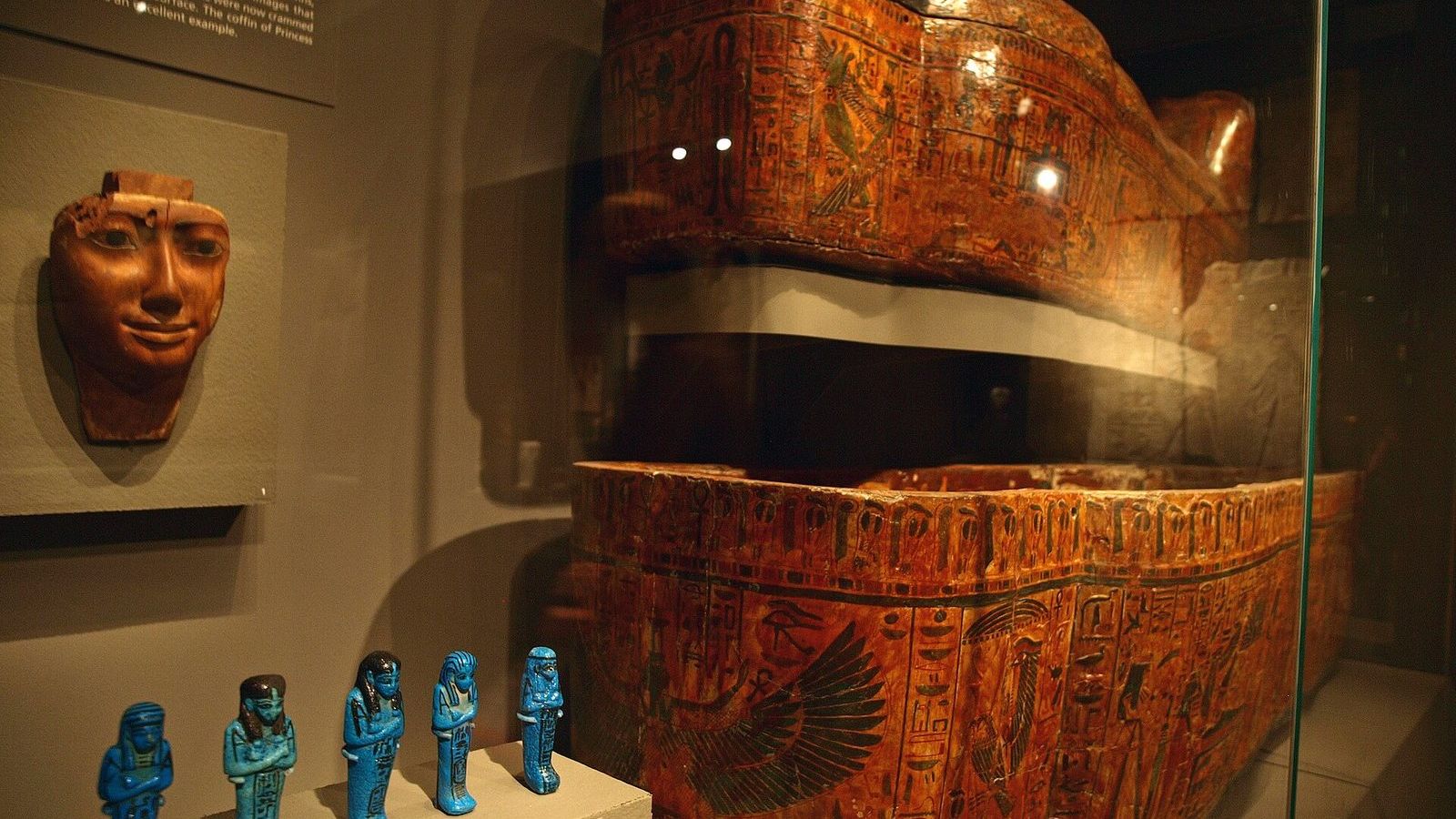
Carter numbered the objects as he removed them, from 1 to 620, with letters for the parts of groups, and the total count of individual items is about 5,400. Among them were six chariots, in pieces; thirty-five boats, as models; one hundred and thirty walking sticks and staves; four hundred and thirteen shabti figures, servants for the next world, with their tools; two daggers, one with a blade of meteoritic iron; six beds; several thrones and chairs; and, in the Treasury, two small coffins containing the mummified bodies of two premature girls, presumably the king's daughters. The king himself lay inside four gilded wooden shrines, nested one inside the other and filling the burial chamber almost to its walls, then a quartzite sarcophagus, then three coffins, the innermost of solid gold weighing about 110 kg. On the mummy's head was the gold mask, which weighs about 10 kg.
The tomb had been robbed twice in antiquity, soon after the burial, and resealed by the necropolis officials; the robbers took small portable valuables, oils, and linen, and left the rest. Carter estimated that about 60 per cent of the jewellery had been taken.
The clearance: ten years
Carter and his team took ten seasons to clear the tomb, from 1922 to 1932. Every object was photographed in place by Harry Burton of the Metropolitan Museum, numbered, recorded on a card, and then taken to a laboratory in another tomb to be conserved before it went to Cairo. The slowness, which the press complained about, is why the record is so good: the Griffith Institute's cards and photographs allow the position of every object to be reconstructed, which no earlier excavation in Egypt had made possible.
The reign: about nine years
Twenty-six of the wine jars in the tomb carry inked dockets with the vintage, the vineyard, and the regnal year, like a modern label. The highest year on them is 9, with one doubtful reading of 10. Since the wine for a burial was taken from the cellars at the king's death, the dockets are the best evidence that Tutankhamun reigned for about nine years, from about 1336 to 1327 BC in the chronology of this program. He came to the throne as a child of about nine, as Tutankhaten, and died at about eighteen or nineteen. The examination of his body in 1925, and the CT scans and DNA studies of 2005 and 2010, have shown a broken leg and evidence of malaria but have not settled what he died of; the claim that he was murdered by a blow to the head, popular for decades, was disproved by the scans.
The parentage: two open questions
Who his parents were is not written anywhere in the tomb. The DNA study of 2010 identified the body in tomb KV 55 as his father and a body from KV 35 as his mother, and argued that they were siblings, children of Amenhotep III; the KV 55 body is usually taken to be Akhenaten, but the identification is disputed, and the study's methods have been questioned. The honest answer is that Tutankhamun was almost certainly a son of Akhenaten and that his mother is unknown.
The aftermath: one death and no curse
Lord Carnarvon died in Cairo on 5 April 1923 of an infected mosquito bite that led to blood poisoning and pneumonia, five months after the discovery. Newspapers invented a curse. Carter himself lived until 1939 and died at sixty-four, and Carnarvon's daughter Evelyn, who entered the tomb on the first night, lived until 1980. A study published in a medical journal in 2002 compared the survival of the people who had been present at the openings with that of those who had not, and found no difference.
The objects are now in the Grand Egyptian Museum at Giza, displayed together for the first time since they left the tomb.
Where this appears in the masterclass
Unit 11 of the Egyptology Masterclass, Amarna and Tutankhamun, tells the story of the discovery, reads the wine jar dockets as a worked case on the reign length, and sets out the questions of the king's death and parentage with the evidence as it stands. Unit 6 uses the tomb as the one nearly intact royal burial of the New Kingdom, and Unit 1 uses the Griffith Institute's archive as an example of what an excavation record should be.