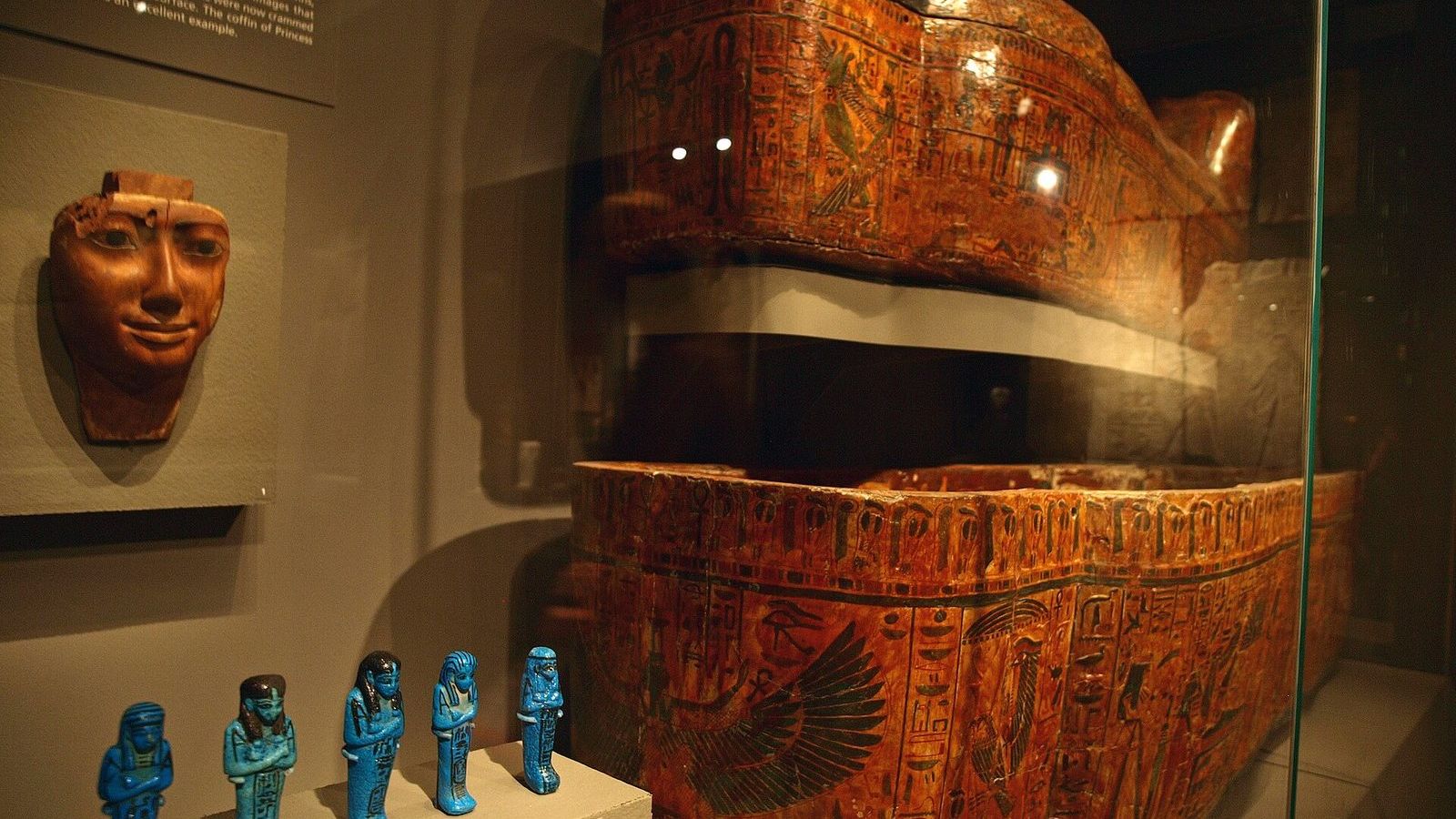
 Image: mararie (CC BY-SA 2.0); the coffin of Henuttawy, Museum of Fine Arts, Boston
How a coffin was recycled
In 1891 workmen clearing sand near the temple of Hatshepsut at Deir el-Bahari broke into a tomb that contained 153 coffin sets, most of them double or triple, belonging to the priests and priestesses of Amun of the Twenty-first Dynasty. The find, known as Bab el-Gasus, the Gate of the Priests, was so large that the Egyptian government gave away whole sets to foreign states, and coffins from it are now in museums from Cairo to Copenhagen and from Boston to Sydney. They are covered inside and out with dense painted scenes on a yellow ground, among the richest of any period. They also contain a secret that took a century to see: many of them had belonged to someone else first.
Reading the surface
Kara Cooney of the University of California, Los Angeles, began the UCLA Coffins Project in the 2000s to examine the Twenty-first Dynasty coffins in museums around the world for signs of earlier use. The signs are of several kinds, and once they are pointed out they are visible to anyone with a torch and patience.
The first is the name. A coffin carried the name and titles of its owner in the offering texts painted down the lid and around the trough. On a reused coffin the old name has been scraped or painted out and a new one written over it, and the new paint often sits on a slightly different surface, or the new name is squeezed into a space made for a shorter one. The second is the plaster. Coffins were made of planks of local wood, covered with a layer of plaster and then painted. A reused coffin frequently has two layers: an older painted surface beneath a newer one, visible at the edges, at cracks, or under the microscope, and sometimes the new layer was applied after the old decoration had been adzed down to a rough surface. The third is the body. Twenty-first Dynasty coffins have a modelled face, hands, and chest. On some, the carved breasts of a woman's coffin have been cut away and a beard added so that a man could use it, or the reverse. The fourth is the fit. A lid and a trough that were not made for each other do not meet cleanly, and a coffin whose outer and inner cases come from different workshops can be spotted by their styles.
Cooney's team has examined hundreds of coffins and has concluded that a majority of those of the Twenty-first Dynasty show at least one of these signs. The practice was not an exception. It was the norm.
The coffins of Henuttawy
The case that this program uses is a coffin set in the Egyptian Museum in Cairo, catalogued as JE 26204, which belonged in its final use to a woman named Henuttawy, a singer of Amun. In 2019 Caroline Arbuckle MacLeod and Kara Cooney published a study of it in the Journal of Egyptian Archaeology, which can be read free of charge at eScholarship. By examining the construction of the wood, the layers of plaster and paint, and the texts, they were able to separate the phases of the set's life: its original manufacture, a reworking, and the final adaptation for Henuttawy, each leaving its own layer. The title of the paper calls it a layered life, which is the right phrase for an object that was not made once but remade.
Why it happened
The Twenty-first Dynasty, from about 1069 to 945 BC, began when the New Kingdom ended. The kings now ruled from Tanis in the Delta, while Thebes was governed by the high priests of Amun, who were generals and sometimes kings in their own right. Egypt had lost Nubia and its gold, and the Levant and its timber. The royal tombs in the Valley of the Kings had been robbed in the last years of the Twentieth Dynasty, in some cases by the officials who were supposed to guard them. The economy, measured by the prices of grain on the ostraca, was in trouble, and good coffin wood, which was cedar from Lebanon, could not be had.
The response of the Theban authorities was to take control of the dead. The high priests ordered the royal mummies gathered from their robbed tombs, rewrapped, labelled, and reburied together in hiding places, of which the most famous is the Royal Cache at Deir el-Bahari, found in 1881 with the bodies of Sety I, Ramesses II, and more than forty others. In the process the gold was removed from the royal burials. The same officials, Cooney argues, oversaw the reuse of private coffins on a large scale: older burials in the Theban cemeteries were opened, the coffins taken, and the bodies disposed of or rewrapped, and the coffins went back into circulation through the workshops. The reuse was a managed response to a shortage, and the evidence that it was sanctioned is that the priests of Amun themselves were buried in reused coffins.
What it tells us
The Egyptians believed that a coffin was essential to the survival of the dead, and the tomb-robbery trials of the Twentieth Dynasty show that stripping a burial was a capital offence. A society in which the priesthood reused coffins as a matter of routine had changed its priorities under pressure. Cooney reads the pattern as evidence for an economy in which the materials of the dead were the only reserve of wealth left to draw on, and for a religious culture that found a way to make the practice acceptable, by treating the reworking as a renewal rather than a theft.
For museum visitors the lesson is more direct. A Twenty-first Dynasty coffin in a gallery is a document with a history. The name on it is the last name it carried, not necessarily the first; the face may have been a woman's before it was a man's; and the texts may belong to two centuries. The label will rarely say so, because the research is recent and museums are slow to rewrite, but the evidence is on the object.
Unit 12 of the Egyptology Masterclass presents Kara Cooney's work as the first of its two research spotlights, in the section on the Third Intermediate Period as an age of scarcity and reuse, and reads the evidence of reuse on the Henuttawy coffins in a worked case. Unit 6 explains what a coffin was for and what a burial cost, which is the background to why anyone would reuse one.