 Image: Papyrus of Hunefer, British Museum (public domain)
What the weighing of the heart really decided
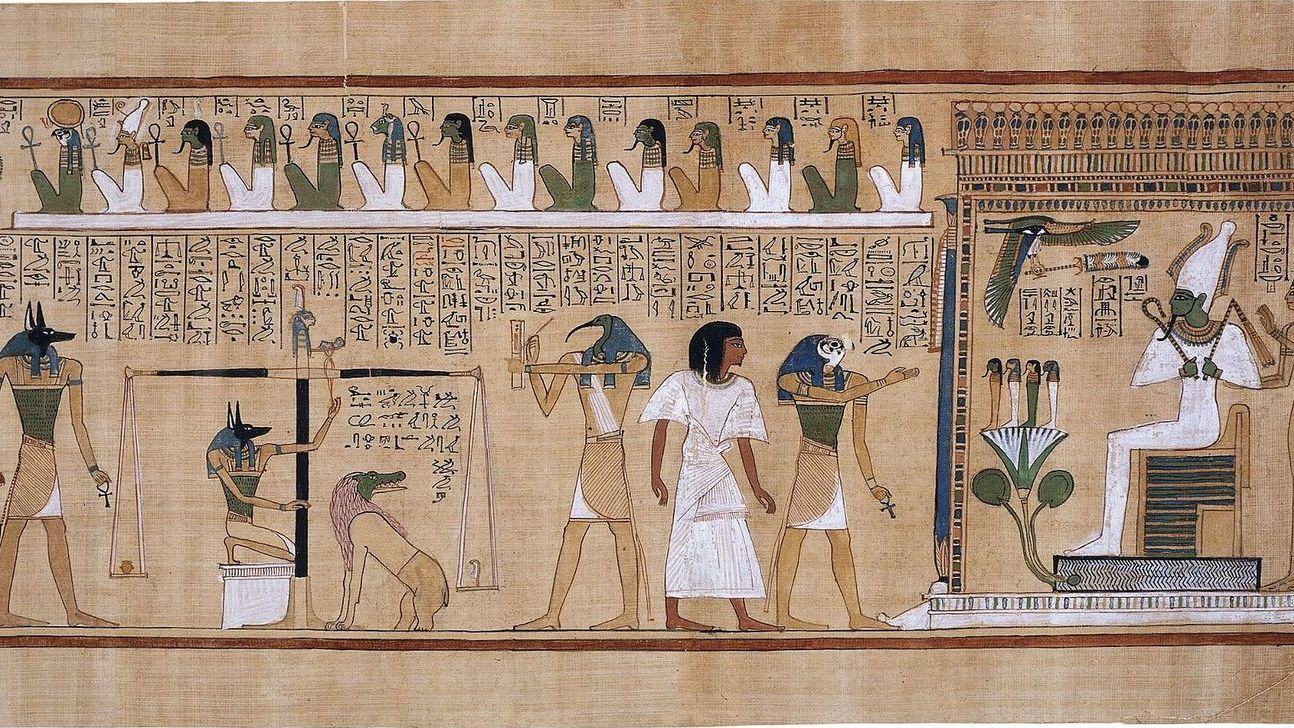
The papyrus of Hunefer in the British Museum was made about 1275 BC for a royal scribe and steward of King Sety I. Its best known section is a single scene, 90 cm long, which has been reproduced in every book on Egypt for a century. It reads from left to right, like a strip cartoon, and it shows what the Egyptians expected to happen to a person after death. Almost every element in it has a name and a meaning, and reading them in order changes what the scene seems to say.
The scene, figure by figure
At the left, Hunefer himself, in a white linen robe, is led by the hand by Anubis, the jackal-headed god of embalming, into the hall. In the centre stands a balance. On one pan is a small jar in the shape of a heart, Hunefer's heart; on the other is a feather, the sign of Maat, the goddess of right order, who also appears as a tiny figure on top of the balance post. Anubis, shown a second time, kneels to check the plumb line and steady the scales. To the right, Thoth, the ibis-headed god of writing, stands with a palette and reed pen and records the result. Behind Thoth sits a creature with the head of a crocodile, the forequarters of a lion, and the hindquarters of a hippopotamus. Her name is written above her: Ammit, the devourer, the swallower of the dead. She is waiting for the heart if it fails.
It does not fail. Further right, Horus, the falcon-headed son of Osiris, leads Hunefer by the hand towards a shrine in which Osiris sits enthroned, green-faced and wrapped as a mummy, with the goddesses Isis and Nephthys standing behind him and the four sons of Horus, the guardians of the embalmed organs, on a lotus in front. Hunefer is presented to the king of the dead as one who has passed. Along the top of the scene a row of fourteen seated gods, the assessors, receive his adoration.
The text behind the picture
The scene illustrates spell 125 of the Book of the Dead, which is a modern name for the collection of about 190 spells that the Egyptians called the Book of Going Forth by Day. Spell 125 is the longest. It opens as the dead person enters the Hall of the Two Truths and addresses Osiris with a declaration: I have not done wrong against people, I have not mistreated cattle, I have not blasphemed, I have not stolen the offerings of the gods, I have not killed, I have not ordered killing, I have not held back water in its season, I have not falsified the weights of the balance. There follow forty-two further statements, each addressed by name to one of forty-two gods who sit in judgement, one for each district of Egypt, and each denying a specific wrong: I have not been greedy, I have not eavesdropped, I have not been hot-tempered, I have not had sex with a married woman. Egyptologists call the list the negative confession or the declaration of innocence.
The spell then supplies the words with which the dead person must answer the gatekeepers of the hall, who demand to know their names before they will let him pass, and it closes with instructions for the person who recites it: to be pure, dressed in white, and anointed, and to know the text by heart.
Why the scales always balance
In no surviving papyrus does the heart outweigh the feather. Ammit is drawn in hundreds of copies of the scene and is never shown eating. This is not because every Egyptian who could afford a Book of the Dead was virtuous. It is because the scene was not a prediction of what would happen but a means of making sure that it happened. The spell gave the dead the words that would secure a verdict in their favour, and the picture showed that verdict already reached. The Egyptians believed that a written and pictured outcome was itself effective; the same principle filled their tombs with pictures of food.
Two further spells make the logic explicit. Spell 30B, inscribed on the heart scarab placed over the chest of the mummy, is addressed to the heart itself and asks it not to stand up against the dead person as a witness, not to oppose him before the keeper of the balance, and not to tell lies about him in the presence of the god. The heart was the seat of memory and conscience, and the fear was that it would testify. Spell 30B was an instruction to it not to. Spell 125 itself ends with the assurance that the one who knows it will be justified, and justified is the word, maa-kheru, true of voice, that is written after the name of every dead person on every coffin and stela. It means that the verdict has gone in their favour.
What the scene therefore decided
The scene decided whether a person had lived according to maat, the order that the gods had set and the king upheld, and the list of denials is the best evidence we have for what the Egyptians thought that order required of a private individual: honesty in trade, restraint in anger and appetite, respect for the gods' property, care for the water of the fields, and loyalty to the king. It is an ethical list, and the Egyptians were the first people to make a person's conduct in life the condition of their survival after death. But the Book of the Dead was also a technology for passing the test, sold by workshops to anyone who could pay, and the test was passed by knowing the right words. Both things are true at once, and the scene of Hunefer holds them together: a real balance, a real devourer, and a verdict that was never in doubt.
The heart was the one organ that the embalmers left in the body, for exactly this reason. Everything else that could decay was removed; the heart had to stay, because it would be weighed.
Where this appears in the masterclass
Unit 6 of the Egyptology Masterclass, Death and the Afterlife, reads the Hunefer scene figure by figure in a worked case and sets spell 125 in the sequence of funerary texts from the Pyramid Texts onwards. Unit 15 reads spell 30B in full from a heart scarab and ten statements of spell 125 in the original Egyptian, with plates, and asks what the spells say about the Egyptian idea of the self.