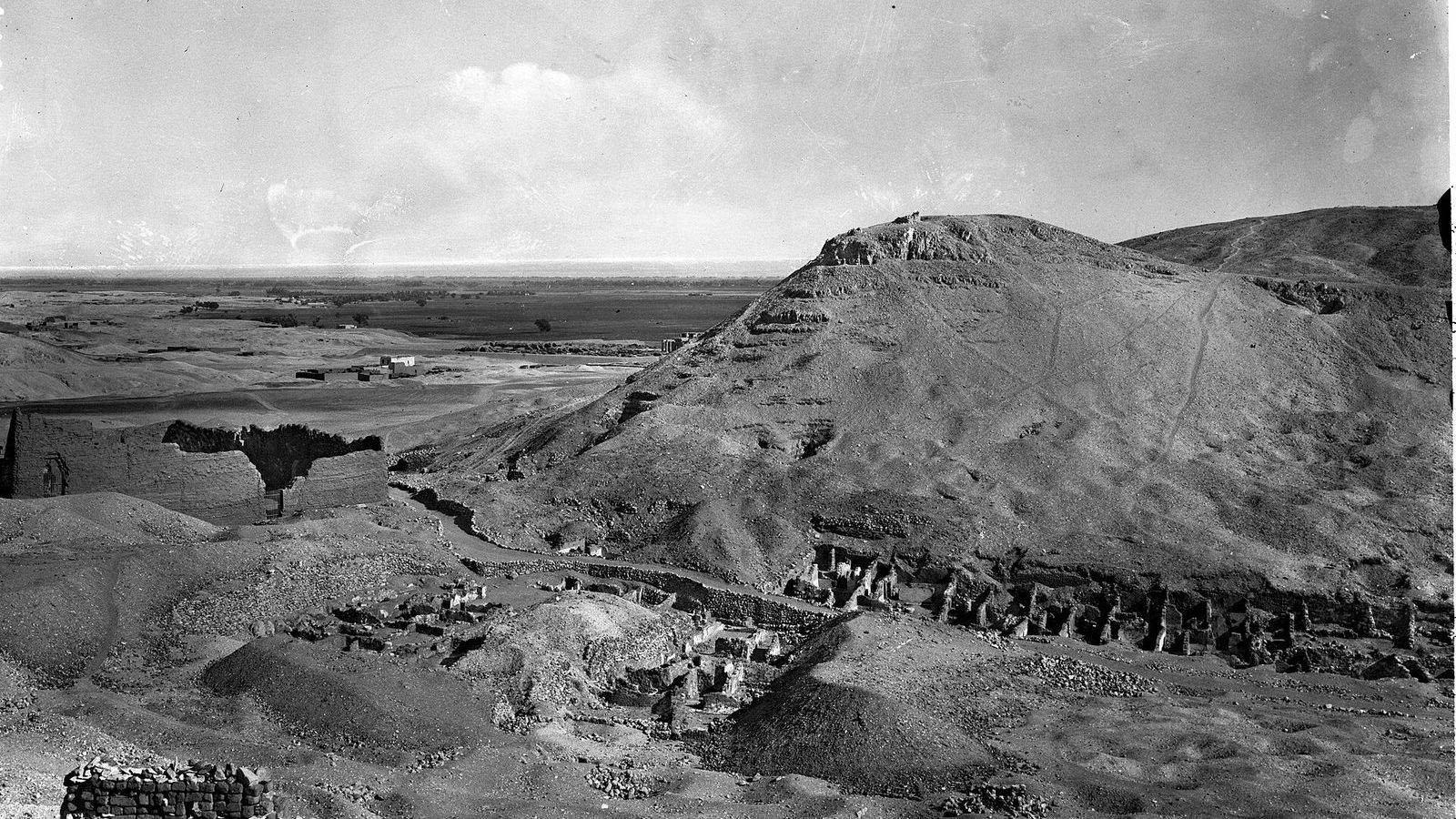
 Image: Archivio fotografico Museo Egizio, Turin (CC0); Schiaparelli's excavations at Deir el-Medina, 1909 to 1914
The woman with thirty tattoos
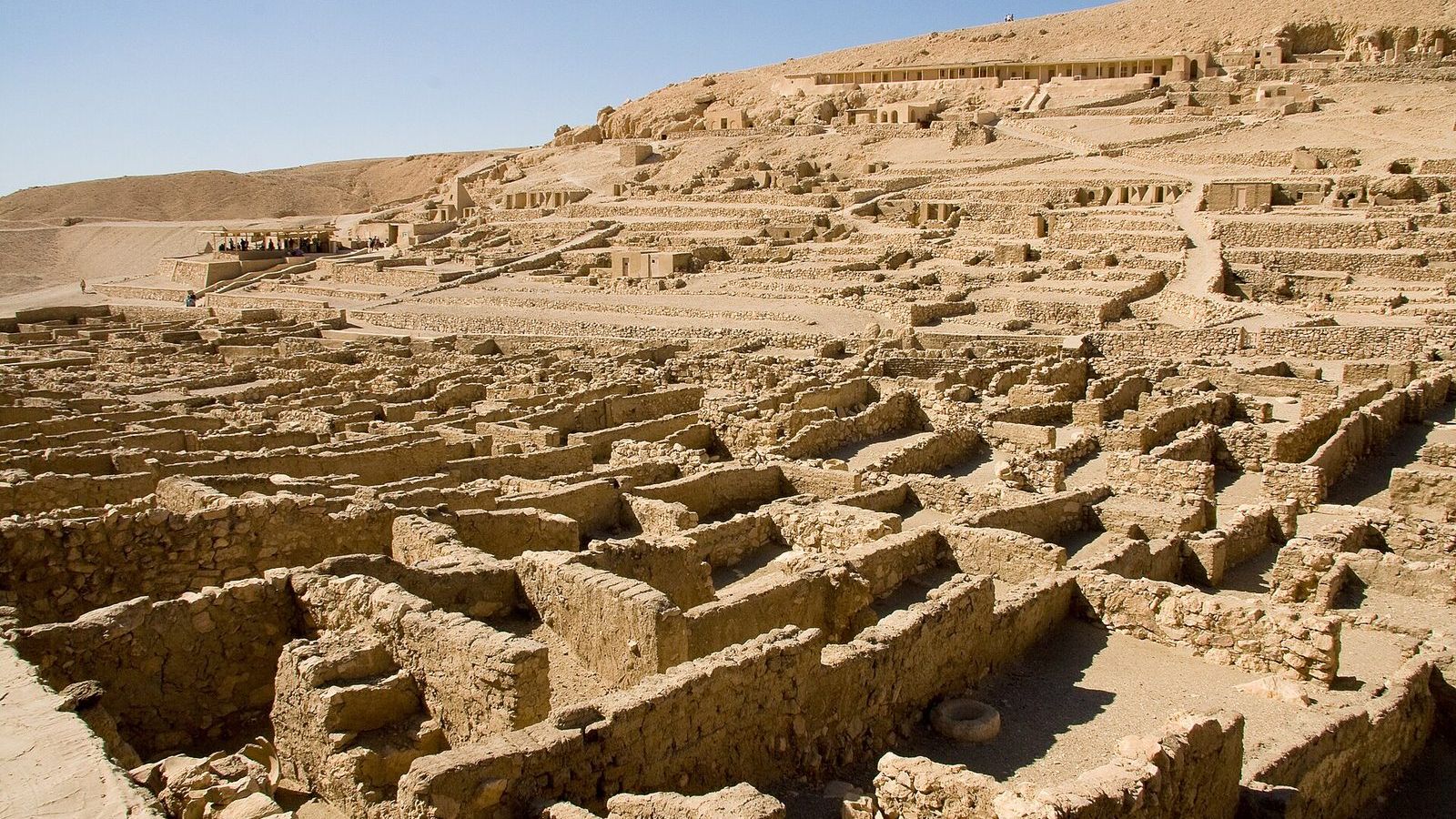
Deir el-Medina, the village of the workmen who built the royal tombs at Thebes, was excavated by the French Institute in Cairo from 1922 onwards, and the Institute still runs the site. Over the decades the excavators collected human remains from the tombs around the village, many of them disturbed in antiquity and most of them fragmentary, and stored them in a tomb on the site. In 2014 Anne Austin, a bioarchaeologist then at Stanford and now at the University of Missouri in St. Louis, was working through these remains with Cédric Gobeil, the director of the mission, to record the health of the villagers. One of the bodies was a headless, limbless torso of a woman, mummified, with the skin preserved. On her neck were marks that looked at first like damage. They were tattoos.
What the camera showed
Tattoos on mummified skin are hard to see. The skin darkens and the pigment, which is carbon, fades into it. Infrared photography separates them, because the carbon absorbs infrared light and the skin reflects it, so that the design stands out dark on a pale background. Austin photographed the torso in infrared and found more than thirty tattoos, far more than on any Egyptian body known before.
On the neck were two wedjat eyes, the eye of Horus, looking outwards, and between them a seated baboon. Baboons were animals of the sun and of Thoth, and the eye was the commonest protective sign in Egypt. On the shoulders and the upper back were more eyes, and on the arms, cows wearing the sun disc and horns of the goddess Hathor, in a row, with a snake beneath. On the hips were lotus flowers, and at the base of the back a line of signs that may read as a wish for protection. Several designs were placed so that they would be seen from a particular angle, for example by someone standing in front of the woman while she had her arms raised, or by someone looking at her back.
The body dates to the Ramesside period, roughly 1300 to 1070 BC, the time when the village was at its largest. Austin and Gobeil published the find in 2017 in the Bulletin of the French Institute, and the paper, with the infrared photographs, can be read free of charge at journals.openedition.org/bifao/296.
Tattoos before her
Tattooing was known in Egypt long before the New Kingdom, but the evidence was thin. The oldest comes from the Predynastic period: two naturally mummified bodies from Gebelein in the British Museum, a man and a woman who died between about 3350 and 3000 BC, carry tattoos that were identified by infrared in 2018, a wild bull and a sheep on the man's upper arm and S-shaped marks on the woman's shoulder. They are the oldest figurative tattoos known anywhere.
From the Middle Kingdom come the tattooed women of Deir el-Bahari, found in 1891 in tombs near the temple of Mentuhotep II. The best known is Amunet, a priestess of Hathor, whose body carried patterns of dots and dashes in lines across the abdomen and on the arms and thighs. Similar patterns appear on the faience figurines of women, often called fertility figurines, that were placed in tombs of the period. For a long time the view in the literature was that tattooing in Egypt was confined to women and was connected with sexuality and childbirth, and the older scholarship sometimes called the women dancers or prostitutes, with no evidence for either.
What the new tattoos mean
The woman of Deir el-Medina changes the picture, because her tattoos are not patterns but images, and the images are religious. Hathor's cows, the eyes of Horus, baboons, lotus flowers, and snakes are the vocabulary of the temples, the amulets, and the votive objects of the New Kingdom. Austin's reading is that the woman was a religious practitioner, perhaps a priestess or a healer, whose body displayed her role, and that the tattoos may have been thought to carry power in themselves, as the same signs did on an amulet. Hathor was the goddess of the Theban west bank and had a chapel at Deir el-Medina, and women of the village held titles in her cult.
This fits other evidence from the village. The ostraca record women of the village with the title of singer of Hathor and as participants in her festivals. The chapel of Hathor on the north side of the village, later overbuilt by the Ptolemaic temple that gave the site its modern name, was the centre of a cult in which women took part. The tattooed woman is the first physical evidence of what one of those women looked like.
Since 2014 the team has examined other bodies from the site in the same way and has found tattoos on several more of them. The number of tattooed individuals known from Egypt has grown quickly in a decade, and it will grow further, because the technique is cheap and the stored remains of a century of excavation have not yet all been photographed.
How the tattoos were made
No tattooing tool has been identified with certainty from Egypt, but a set of bronze points bound together, found at Gurob and now in the Petrie Museum in London, has been proposed as one. The pigment was soot or charcoal. The lines of the Deir el-Medina tattoos are fine and confident, and some of the cows are drawn in the same proportions as cows in the tomb paintings of the period, so the tattooist was an artist in the village style. Whether she tattooed herself or was tattooed by another woman, and at what age, the body cannot say.
Where this appears in the masterclass
Unit 7 of the Egyptology Masterclass, Life in the Black Land, takes Deir el-Medina as its anchor and presents Anne Austin's work as its research spotlight after the section on health and medicine, with an excursion on the tattooed women of the village. The paper is linked in the unit, and the infrared photographs in it are worth the visit on their own.