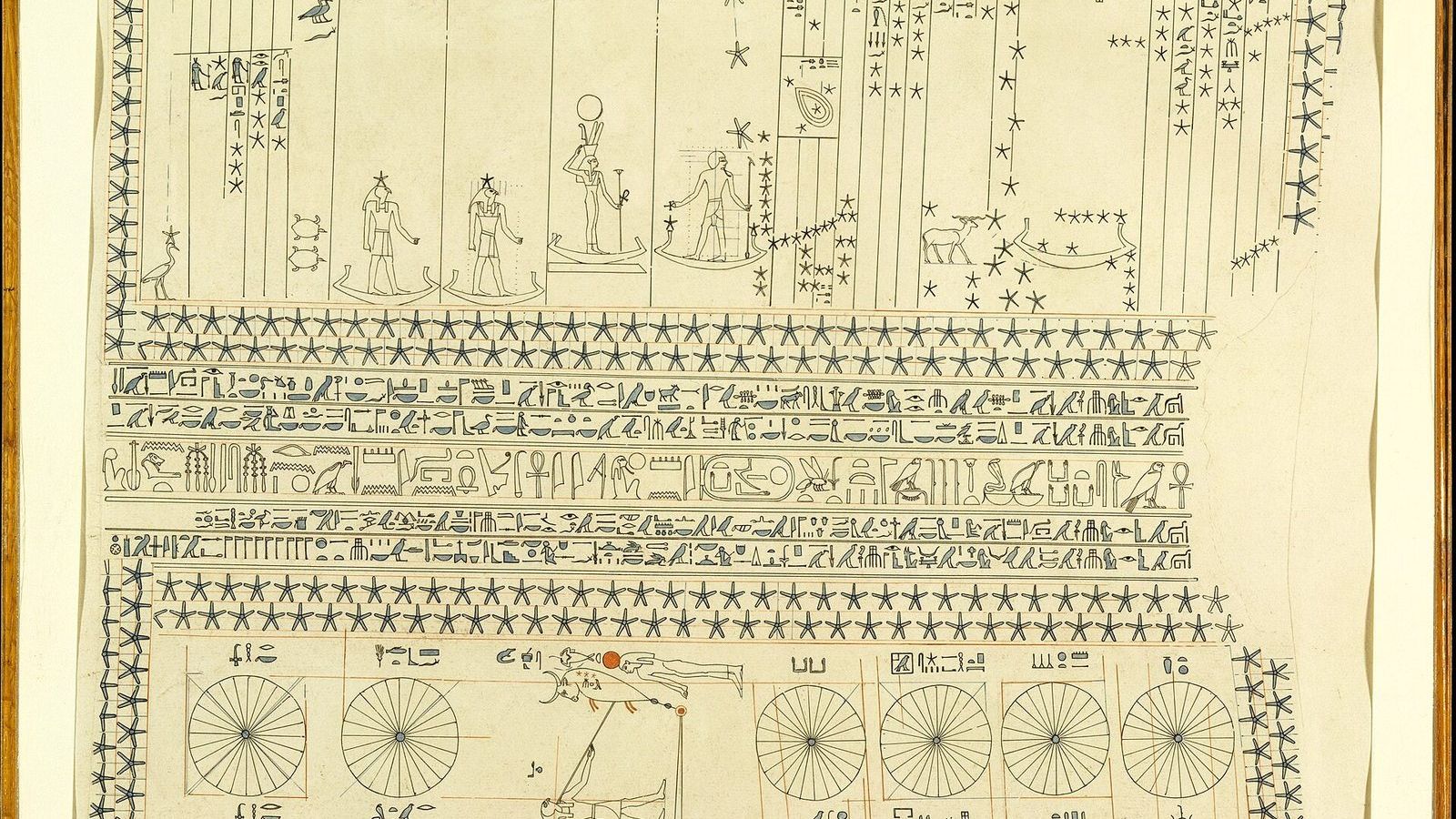
 Image: Charles K. Wilkinson, facsimile of the astronomical ceiling of Senenmut, Metropolitan Museum of Art (CC0)
Why the Egyptians had no leap year
The year of the Egyptian civil calendar had twelve months of thirty days each, grouped into three seasons of four months, plus five extra days at the end. That makes 365. The true solar year, the time from one summer solstice to the next, is 365 days and a little under six hours, which is why our calendar adds a day every four years. The Egyptians never did. Their calendar slipped one day behind the sun every four years, and after 120 years the slip was a month. A festival of the inundation that had fallen in the flood season when a king was young fell in the growing season by the time his great-grandchildren were old. The Egyptians knew this, wrote about it, and kept the calendar as it was for three thousand years.
The shape of the year
The three seasons were named after what the river did. Akhet was the inundation, when the Nile covered the fields; Peret, the emergence, when the water went down and the crops were sown and grew; and Shemu, the low water, when the harvest was brought in. Each had four months, which were at first simply numbered: the first month of Akhet, the second month of Akhet, and so on. Later each month took the name of a festival, and those names survive in the Coptic calendar today, Thoth, Paopi, Hathor, and the rest. Dates were written in the form that Egyptologists transcribe as II Peret 10, the tenth day of the second month of the growing season.
The five extra days were called the days upon the year. Myth made them the birthdays of Osiris, Horus, Seth, Isis, and Nephthys, born on days that the god Thoth had won at draughts from the Moon so that the sky goddess could give birth. They were unlucky, and the texts recommend staying at home.
The star that marked the year
The civil calendar had a natural anchor. Sirius, the brightest star in the sky, which the Egyptians called Sopdet, disappears from view for about seventy days each year when it is too close to the sun, and then reappears in the dawn sky just before sunrise. This first morning appearance, the heliacal rising, happens in Egypt in July, within a few days of the start of the Nile flood. The Egyptians took the rising of Sopdet as the signal of the new year and ideally the first day of Akhet fell on it. Because the calendar had no leap day, the two came apart almost at once. The rising of Sirius moved through the civil year, a day later every four years, and returned to the first day of Akhet only after 1,461 civil years, which is 1,460 years of the sun. This period is called the Sothic cycle, from the Greek form of the star's name.
A Roman writer, Censorinus, records that the rising of Sirius fell on the first day of the Egyptian year in AD 139. Counting back by 1,460 years puts the previous coincidence around 1320 BC and the one before that around 2780 BC, within a few decades of the first dynasties. Some Egyptologists have argued that the calendar was invented at that earlier coincidence, which would make it one of the oldest calendars in continuous use anywhere, but the argument is circular and the date of the calendar's introduction is not known.
Why they left it alone
It was not ignorance. Egyptian astronomers tracked the rising of Sirius and the Moon with care, and the temples kept a second calendar, based on the Moon, for fixing festivals. The civil calendar was the calendar of the state: taxes, wages, regnal years, and the work journals of Deir el-Medina all ran on it, and its merit was exactly that it never changed. A year of 365 days with no exceptions could be counted forward and backward without error by any scribe. The drift against the seasons was a known nuisance, handled by moving festivals with the lunar calendar, rather than a defect to be fixed.
The one attempt to fix it came from a Greek king. In 238 BC the priests assembled at Canopus decreed, at the wish of Ptolemy III, that a sixth day be added to the five every fourth year, so that the festivals would stop wandering. The decree was cut in stone in three scripts, like the Rosetta Stone fifty years later, and was ignored. The priests of Egypt went on with the old year. Two centuries later, in 46 BC, Julius Caesar reformed the Roman calendar with the help of an astronomer from Alexandria, Sosigenes, and gave Rome the leap day that Egypt had refused. In 25 BC Augustus imposed the same reform on Egypt itself, and the Alexandrian calendar with its leap day every fourth year is the one the Coptic church uses now.
How the drift dates history
Because the drift is regular, any Egyptian text that records the rising of Sirius on a specific civil date gives the year, or at least a narrow range of years, in which it was written. Only a handful of such records survive, and they are precious. A papyrus from the town at Lahun notes that the rising of Sopdet would fall on the sixteenth day of the fourth month of Peret in the seventh year of Senusret III. A calendar on the back of the medical Ebers Papyrus records a rising on the ninth day of the third month of Shemu in the ninth year of Amenhotep I. Each fixes a reign to within a few decades, depending on where in Egypt the observation was made, since the date of the rising shifts by a day for every degree of latitude. These Sothic dates are the pegs on which the Middle Kingdom and the early New Kingdom hang, with the king lists stretched between them, and the radiocarbon dates of the last fifteen years have confirmed them.
The 365-day year also had a long afterlife. Greek astronomers in Alexandria adopted it for their tables precisely because it was so regular, and Ptolemy's Almagest of the second century AD reckons in Egyptian years. Copernicus was still using them in 1543.
Where this appears in the masterclass
Unit 1 of the Egyptology Masterclass introduces the civil calendar, the three seasons, and the Sothic drift in its section on time, with a ring diagram of the year and an interactive timeline ruler. Unit 8 builds a date from the Lahun observation in a worked case and explains how king lists, astronomy, synchronisms, and radiocarbon are fitted together into one chronology. Unit 5 returns to the calendar for the festivals of the temple year.