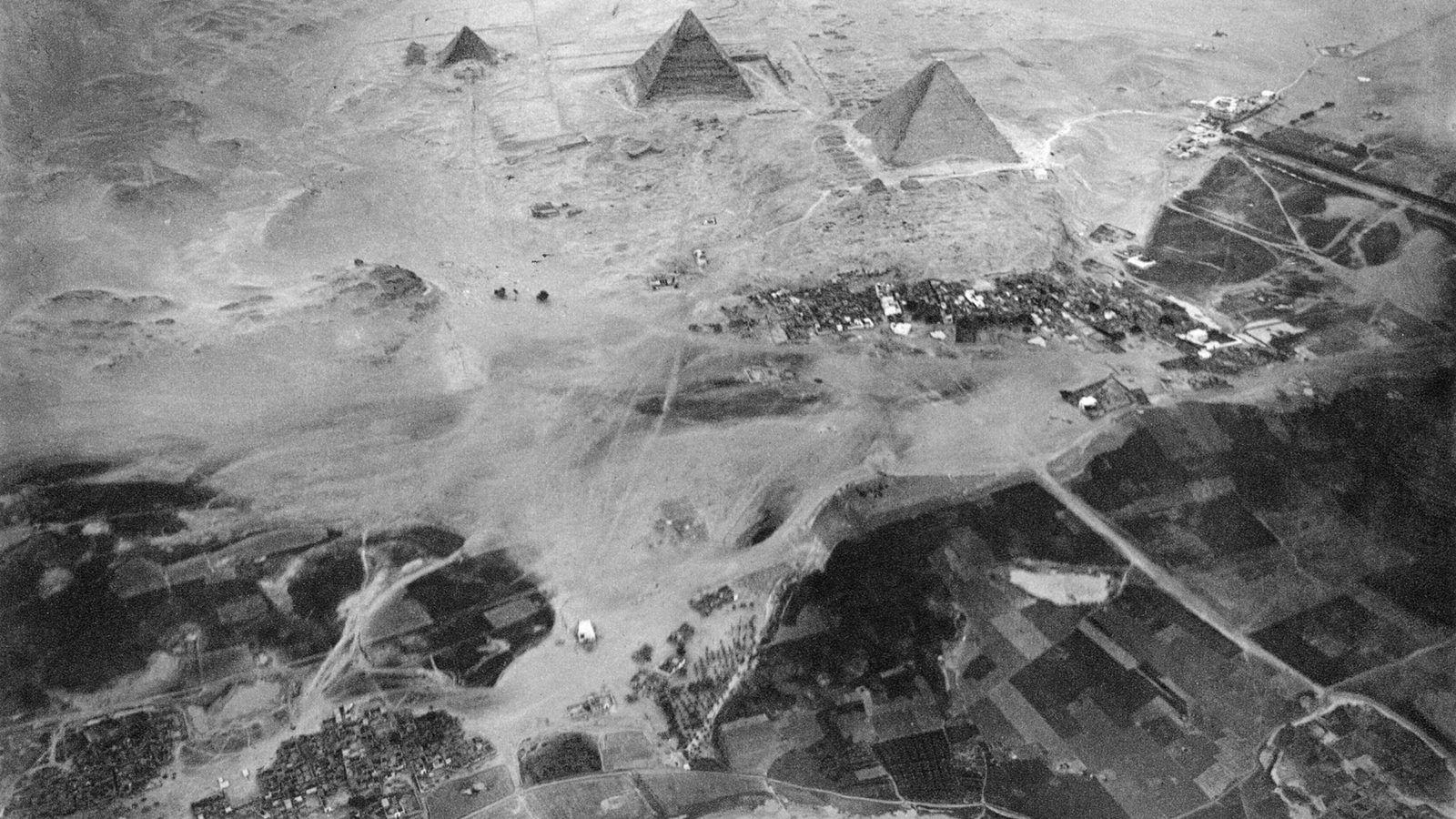
 Image: Eduard Spelterini, 1904 (public domain)
Why Cleopatra lived closer to us than to the pyramids
Start with three dates. The Great Pyramid of Khufu was built in a reign that the chronology used by this program puts at about 2589 to 2566 BC. Cleopatra VII, the last ruler of Ptolemaic Egypt, killed herself in Alexandria in 30 BC. Neil Armstrong stepped onto the Moon on 20 July 1969. From the pyramid to Cleopatra is about 2,540 years. From Cleopatra to the Moon is 1,999 years. When Cleopatra looked at the pyramids, and she certainly did, since Alexandria lay a day's ride from Giza, she was looking at something older to her than she is to us.
The same arithmetic, several times over
The comparison works at every level of Egyptian history, because the history is so long. The civilization that we call ancient Egypt ran from the unification of the valley around 3100 BC to the closing of the last temples in the sixth century AD, about 3,600 years. The whole of recorded European history since the fall of Rome is less than half of that.
Within that span, the periods that museum labels run together were far apart. The Narmer Palette, carved around 3100 BC, was already more than five centuries old when the Great Pyramid went up, older to Khufu than the plays of Shakespeare are to us. The Step Pyramid of Djoser at Saqqara, the first stone building of its size in the world, was about 1,300 years old when Ramesses II came to the throne. Tutankhamun, whose tomb was found in 1922, lived about 1,300 years before Cleopatra; she was as far from him as we are from Charlemagne. The scribes who copied the Tale of Sinuhe in the Ramesside period were copying a text already six hundred years old.
In generations
Years are hard to feel. Generations are easier. If a generation is taken as twenty-five years, the 3,070 years from Narmer to Cleopatra are about 123 generations. A child born in the reign of Cleopatra could, in principle, have traced a line of 120 ancestors back to the first kings. For comparison, 123 generations before the present day takes us to about 1100 BC, the end of the New Kingdom, which is itself ancient Egypt.
A different measure is the lifetime of a monument. The Great Pyramid was the tallest building on Earth for about 3,800 years, until the spire of Lincoln Cathedral passed it in the fourteenth century AD. No later structure has held the record for a tenth of that time.
What the Egyptians knew of their past
The Egyptians were aware of the depth of their own history, and they kept records of it. The Palermo Stone, a slab of basalt inscribed in the Fifth Dynasty, lists the kings back to the First Dynasty year by year, with the height of the Nile flood in each. The Turin King List, a papyrus of the reign of Ramesses II, gives the names and reign lengths of some three hundred kings from the gods down to the Second Intermediate Period, in order, with subtotals. The priest Manetho, writing in Greek under the first Ptolemies, organized the same material into the thirty dynasties that we still use. Egyptians of the late periods knew that there had been an Old Kingdom and that its monuments stood near Memphis.
They also visited them. Graffiti left by New Kingdom scribes on the walls of the Step Pyramid complex and of the pyramid temples of Saqqara record day trips made around 1400 BC to admire buildings that were then more than a thousand years old. One scribe wrote that he had come to see the temple of Djoser and found it as if heaven were within it. Khaemwaset, a son of Ramesses II and high priest of Ptah at Memphis, went further: he had the names of the Old Kingdom kings recut on their pyramids and statues, with a note that he had restored them because they had fallen into decay. He has been called the first Egyptologist, and he lived about 1250 BC, closer to Khufu than to us by a wide margin, but still 1,300 years after him.
Later still, the kings of the Twenty-fifth and Twenty-sixth Dynasties, in the eighth and seventh centuries BC, deliberately copied the art and the titles of the Old Kingdom. Their sculptors went to the tombs of Saqqara and Giza and drew the reliefs. A statue made in 650 BC can look, to an untrained eye, like one made in 2450 BC, which is the main reason museum dating is harder than it seems. The archaism was a political statement: the kings were claiming to restore an Egypt that had existed two thousand years before them.
What they did not know
The Egyptians' sense of their past was not ours. Their king lists ran smoothly back from kings into gods, and they had no concept of prehistory, of a time before kingship when people lived in villages on the desert edge and made pots with wavy handles. They did not know that the Sahara had been green when their ancestors moved into the valley, or that the pyramids were the end of a development from mud-brick tombs rather than the beginning of everything. They knew the names of the ancient kings and the lengths of their reigns, and they revered them, but their explanation of why things were as they were was mythological. The Egyptian past was a long time of right order, occasionally interrupted, under a line of kings who were all the same king.
Modern chronology, by contrast, is built from their king lists corrected by astronomy, by synchronisms with the dated records of Assyria and Babylon, and since the 2010s by radiocarbon dating with statistical modelling. The three dates at the top of this article come from that work. The first of them, Khufu's reign, is conventional and could be wrong by a few decades; the Egyptians themselves did not give him a date, only a reign length. The second is exact to the year, because the Greek and Roman sources give it. The third is exact to the minute.
Where this appears in the masterclass
Unit 1 of the Egyptology Masterclass introduces the reference chronology and the rule that every date before 664 BC is approximate. Unit 8, Three Thousand Years of Egypt, prints the chronology in full and ends with the big picture: what changed and what did not over three thousand years, and how the Egyptians themselves saw their past. A worked case there measures the distance from Narmer to Cleopatra in generations, as this article has done.