

The Nile and the First Kings
How farming villages along the river grew into the Naqada cultures, and how the first kings united Egypt about 3100 BC, as the Narmer Palette records. The unit shows how Petrie put pottery in order before any dates were known, what the labels of tomb U-j say about the beginnings of writing, and how radiocarbon now dates the First Dynasty.
Egypt is the oldest territorial state we know, and it did not begin with a king. It began with rain that stopped falling, with herders who walked their cattle down to a river, and with pots. For the thousand years before the first royal tomb, the pottery that people placed in graves is nearly the only calendar we have. This unit follows the valley from the farming villages of the fifth millennium BC to the First Dynasty, and it shows at each step what the evidence is and how far it carries: the sequence of pots, the labels in a tomb at Abydos, a carved palette from Hierakonpolis, the royal cemetery with its hundreds of subsidiary graves, and the radiocarbon model that now dates the whole story.
1 The end of the wet Sahara
For most of the ten thousand years before 5000 BC the Sahara was green. From about 12,500 BC, in a period that climate scientists call the African humid period, the summer monsoon, the seasonal rains of the tropics, reached far further north than it does today, and the land west of the Nile carried grass, acacia trees, seasonal lakes, and herds of gazelle, giraffe, and wild cattle. People lived there, and one site shows how their life changed. At Nabta Playa, about 100 km west of Abu Simbel in the far south of Egypt, the seasonal camps of the ninth and eighth millennia BC, that is, of the years around 9000 to 7000 BC, had grown by the seventh millennium into settlements with rows of huts and with wells deep enough to hold water all year. Their inhabitants made pottery, kept sheep and goats that had come from Western Asia, and herded cattle.
The rain did not last. The monsoon belt moved south again in several steps, and around 5300 BC the Eastern Sahara began to dry out for good. Lakes shrank, the pastures failed, and the herders of the desert had three choices, which were to follow the rain south into what is now Sudan, to settle in the oases, or to move to the one place in the region where water was certain. That place was the Nile valley, where the river flooded every summer whatever the rain did and renewed the Black Land of Unit 1 with fresh silt each year. Archaeologists describe the cause of this movement with a dry word, desiccation, which means the drying out of a region, and it is the first cause in the story of Egypt. People came to the river because the desert pushed them there.
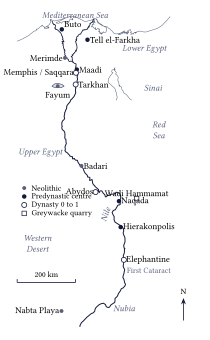
The earliest farming villages of the valley are known from three regions, which are marked in Figure 1. In the Fayum, the depression west of the river with its lake, Gertrude Caton-Thompson (1888-1985) excavated in the 1920s rows of storage pits lined with basketry and still holding grains of emmer wheat, an early kind of wheat, and of barley, the crops that had been domesticated in Western Asia and reached Egypt in the fifth millennium BC. The people who dug these granaries left no solid houses and still moved with the seasons. At Merimde Beni Salama on the western edge of the Delta, found by Hermann Junker (1877-1962) in 1928, a village of oval huts covered at least 40 hectares, which is about 0.4 square kilometres or more than fifty football pitches, and was occupied from about 4800 to 4300 BC; its dead were buried inside the settlement, crouched and without grave goods, the objects placed in a grave beside the dead. The third region is the eastern bank around Badari in Middle Egypt, where Guy Brunton (1878-1948) and Caton-Thompson excavated between 1922 and 1931 about forty small settlements and some six hundred graves. This Badarian culture is the earliest farming culture of Upper Egypt. Its people grew wheat and barley, kept cattle, sheep, and goats, and buried their dead with care, wrapped in matting with the head to the south and the face to the west, with ivory spoons, shell beads, and thin-walled pottery whose polished red surface was rippled with a comb and whose rim had been turned black in the kiln.
The Badarian pottery and body ornaments resemble finds from the Sudanese Nile and the desert cemeteries more than they resemble Merimde, and the excavated Badarian settlements are thin scatters of hearths and pits rather than villages, which suggests that these were still partly mobile herders who returned to the same burial grounds generation after generation. The radiocarbon model that Section 6 describes puts the Badarian between about 4400 and 3750 BC. Everything that follows grew out of this stretch of the valley and the valley south of it, while the villages of the Delta kept their own pottery and their simple graves for another thousand years.