 Image: Warren LeMay (CC0)
Did Khufu's builders use the stars?
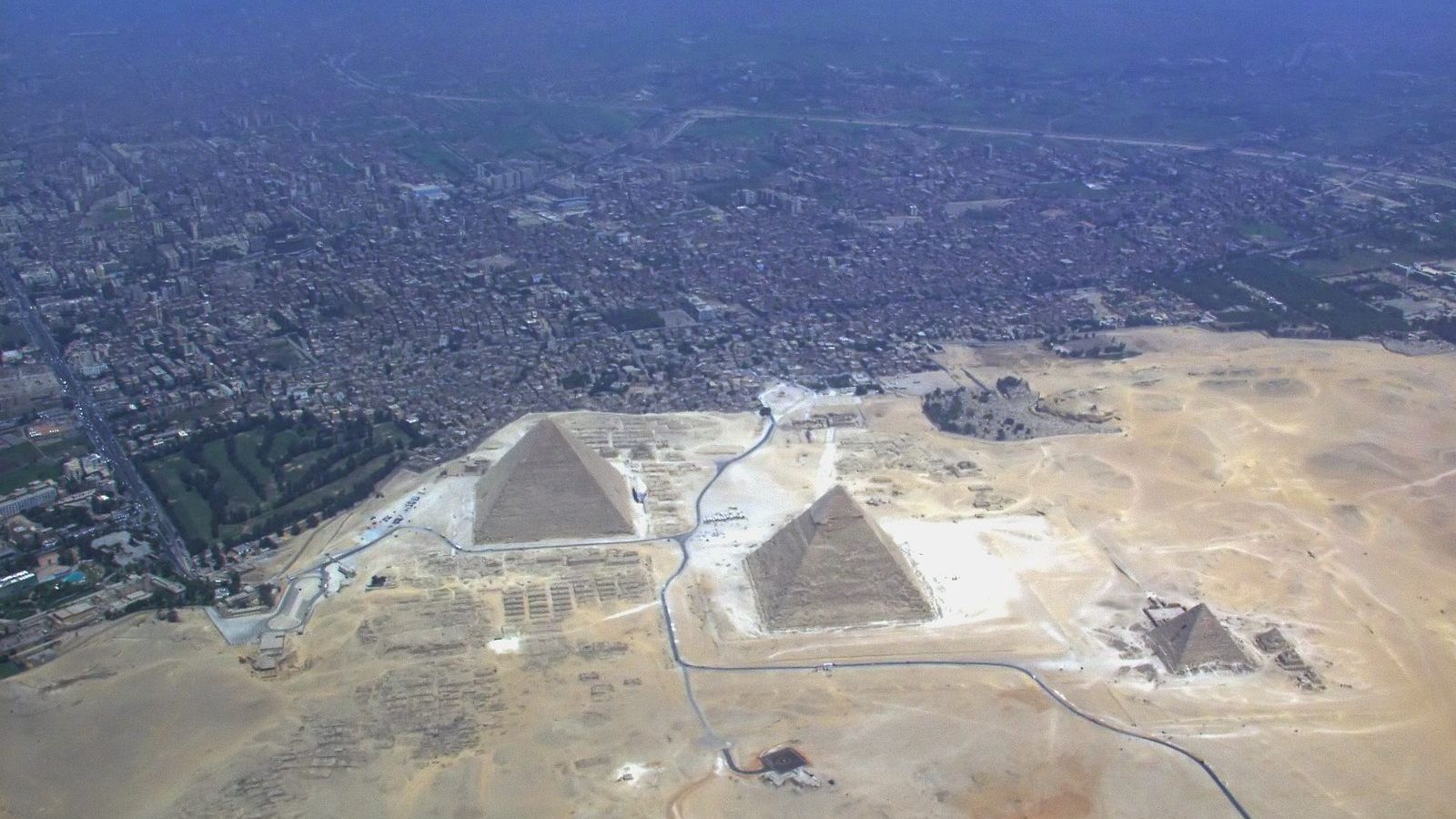
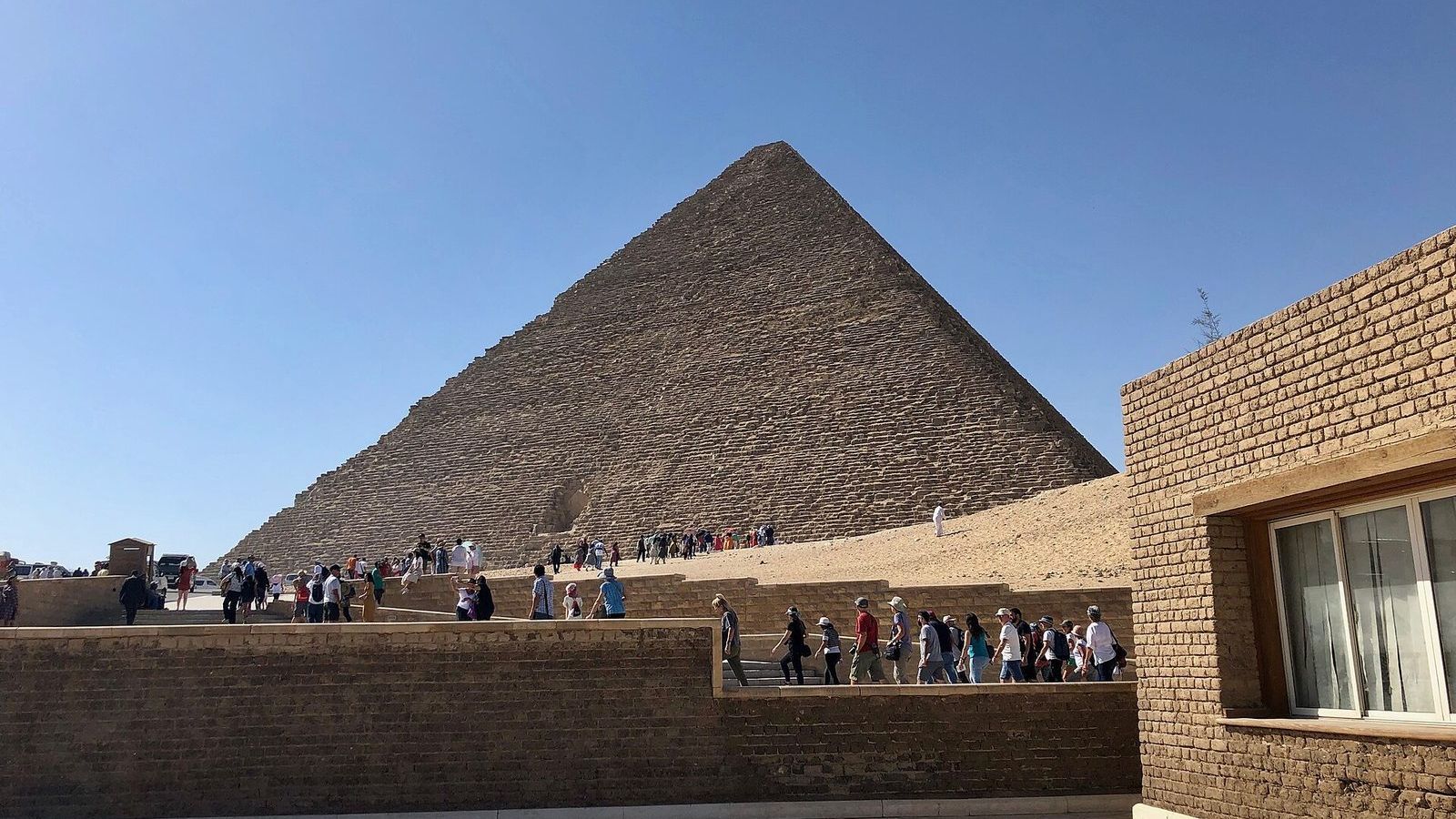
Stand at the north-east corner of the Great Pyramid and sight along its north face. You are looking almost exactly west. The four sides of the pyramid are aligned to the cardinal directions with an error of only a few arcminutes, a few hundredths of a degree, which over the 230 m length of a side amounts to a few tens of centimetres. Flinders Petrie measured it in 1881 and found the sides turned very slightly west of north; modern surveys give a mean error of about 4 arcminutes. Khafre's pyramid next to it is aligned nearly as well. This is better than a compass can do, and the Egyptians had no compass. The question of how they found north has been argued over for a century.
The methods on offer
There are only a few ways to find true north without instruments. One is the sun: plant a vertical pole, mark the tip of its shadow through the day, and the line joining two points where the shadow has the same length runs east to west. Another is the stars: the sky turns around the celestial pole, and a star near the pole can be observed at its highest or lowest point, or two stars on opposite sides of the pole can be observed when one is directly above the other. The Egyptians certainly watched the northern stars; the Pyramid Texts call them the imperishable ones, because they never set, and the so-called air shafts of the Great Pyramid point towards them.
A stellar method has to cope with precession, the slow wobble of the Earth's axis that moves the celestial pole through the stars in a circle of 26,000 years. In 2500 BC there was no bright star at the pole as there is today. Any method that used stars near the pole would therefore drift out of true by a small amount every year, and that is what gave an Egyptologist her idea.
Spence's hypothesis
In November 2000 Kate Spence of the University of Cambridge published a short paper in the journal Nature. She collected the measured orientations of the pyramids from Meidum to the Fifth Dynasty and plotted their errors against the order in which they were built. The errors were not random. They changed steadily from one reign to the next, passing through zero around the time of Khufu and Khafre, and the pattern looked like the trace of precession.
Her proposal was that the builders used two stars, Kochab in the Little Bear and Mizar in the Great Bear, which in the twenty-sixth century BC lay on opposite sides of the pole at about the same distance from it. When a plumb line hung in front of the sky showed the two stars one directly above the other, the line pointed at the pole and so at true north. The method is simple and needs only a plumb line and a clear night. Because of precession, the moment at which the two stars stood vertically above each other pointed exactly north only in one year, around 2467 BC; before that it pointed slightly to one side, and after it to the other, with the error growing by about a third of an arcminute per year.
If the builders used this method, then the error of each pyramid is a clock. Spence read the Great Pyramid's error as a date of 2480 BC, give or take five years, for the laying out of its base. That is about seventy years later than the conventional date for Khufu's reign, which the chronology of this program gives as 2589 to 2566 BC, and it would shorten the Fourth Dynasty.
The objections
The paper caused a long argument, which is still running. The objections are of three kinds.
The first is about the data. The orientations of the earlier and smaller pyramids are less well measured than Giza's, and some of the points on the plot depend on surveys made before modern instruments. Other scholars have plotted the same pyramids and read a different trend, or none.
The second is about the stars. The astronomer Juan Antonio Belmonte and others pointed out that other pairs of stars, such as Megrez and Phecda in the Great Bear, would also have been vertical at the right moments and would fit the data with a different date. A method that fits the data with several star pairs and several dates cannot fix the date on its own, and the choice of pair is a guess.
The third is about the method. A solar method with a pole and its shadow also produces small errors that depend on the time of year the work was done, and recent surveys of the Great Pyramid and of Khafre's pyramid have been used to argue that the errors fit a solar method at the autumn equinox at least as well as a stellar one. The Egyptians' own texts describe a foundation ritual called stretching the cord, in which the king and a goddess fix the corners of a building by sighting the stars, but the ritual is a ceremony and does not say which stars or how.
What the dispute is really about
Nobody disputes the precision; it is measured. Nobody disputes that the Egyptians could observe the stars; they had a calendar built on the rising of Sirius. The dispute is about whether a pattern in six or eight numbers is a signal or noise, and about whether an elegant method that fits the numbers is therefore the method that was used. It is a fair example of how Egyptology argues: a hypothesis published in a physics journal, answered by astronomers and surveyors, and still open twenty-five years later, because the only evidence that would settle it, an Egyptian description of the procedure, does not exist.
The radiocarbon dates for the Old Kingdom, discussed in another article on this site, give Khufu a reign in the twenty-sixth century BC and do not support a date as late as 2480 BC, though their ranges are wide. On balance the conventional chronology stands, and Spence's hypothesis remains a hypothesis. It is still the only one that explains why the errors of the pyramids change sign from one reign to the next.
Where this appears in the masterclass
Unit 4 of the Egyptology Masterclass presents the orientation of the pyramids and Spence's hypothesis in an Evidence in Detail box, with the drift of the two stars drawn from the published figures and the dispute named, and asks the reader to work out in a worked case what the alignment implies for the date of Khufu. Unit 1 introduces the convention that every date before 664 BC is approximate, which is the frame in which the argument belongs.