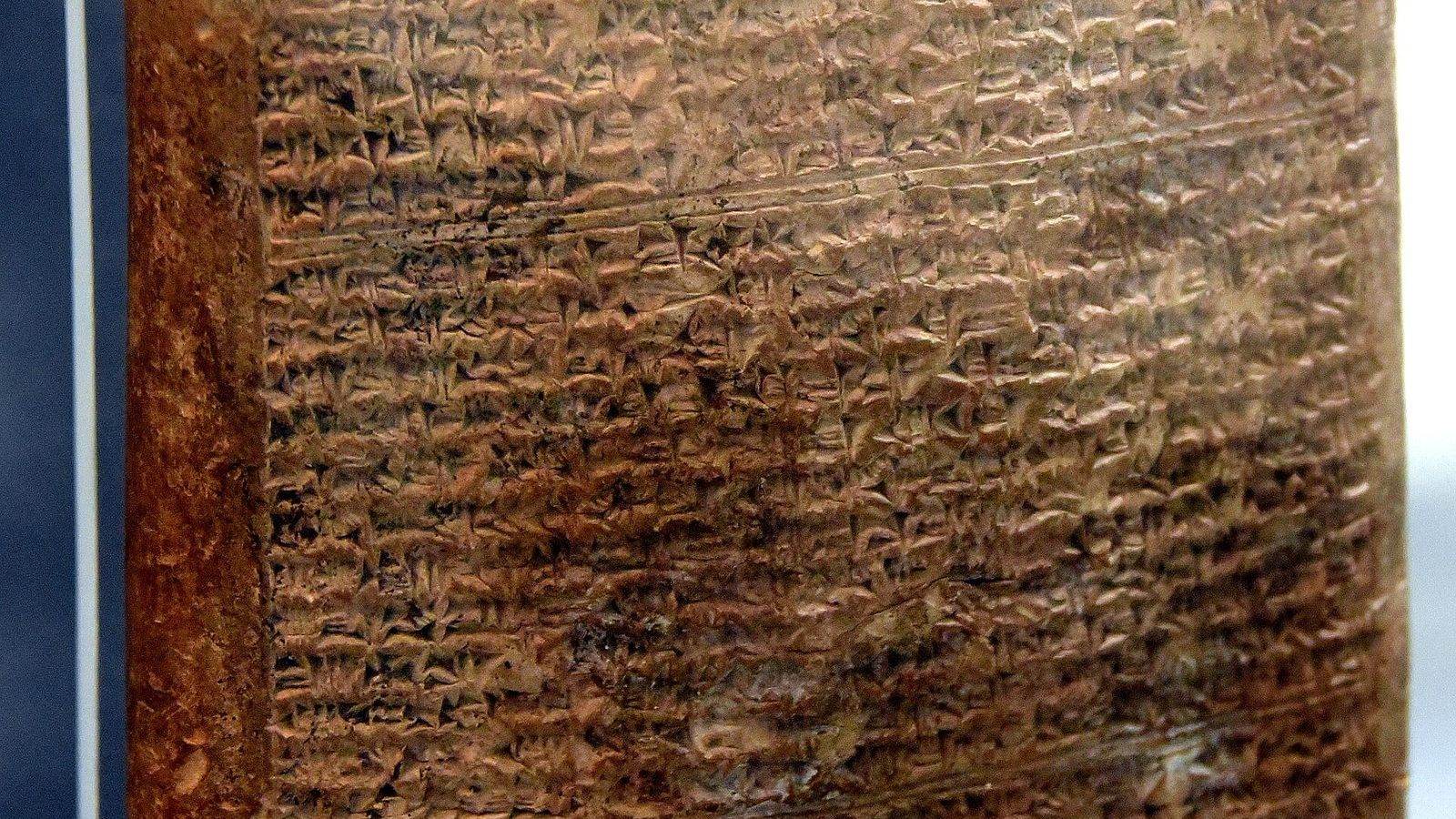
 Image: Osama Shukir Muhammed Amin (CC BY-SA 4.0); a letter from Tushratta of Mitanni to Amenhotep III, British Museum
The Amarna letters, the oldest diplomatic archive
Akhetaten, the city that Akhenaten built in Middle Egypt and that we call Amarna, was abandoned a few years after his death and never reoccupied. Its mud-brick ruins lay under the sand for three thousand years, which is why it is the best preserved city of ancient Egypt. In 1887 a local woman digging in the ruins for the nitrogen-rich decayed brick that farmers used as fertilizer came upon a cache of baked clay tablets. They were sold in pieces, doubted as forgeries, and then recognized in Berlin and London for what they were: the archive of the royal office that handled the foreign correspondence of Egypt under Amenhotep III and Akhenaten.
The archive
About 382 tablets are known, numbered EA 1 to EA 382 in the edition of Jørgen Knudtzon that still provides the standard reference. Most are in the Vorderasiatisches Museum in Berlin, the British Museum, and the Egyptian Museum in Cairo. They were found in a building that the excavators later identified from stamped bricks as the Place of the Letters of Pharaoh, the records office of the central city. They span about thirty years, from late in the reign of Amenhotep III to the reign of Tutankhamun, roughly 1360 to 1330 BC.
Almost all of them are written in Akkadian, the Semitic language of Babylonia, in cuneiform on clay, because Akkadian was the international language of the Near East in the Late Bronze Age, as French was in the Europe of the eighteenth century. The Egyptian court employed scribes trained in it, and a few school tablets with Babylonian myths and word lists were found with the letters. A handful are in other languages: one long letter in Hurrian from Mitanni, and two in Hittite, exchanged with the kingdom of Arzawa in western Anatolia.
The two kinds of letter
The letters fall into two groups that use different rules. About fifty are from the Great Kings, the rulers of Babylon, Assyria, Mitanni, Hatti, Arzawa, and Alashiya, which is Cyprus. They address the king of Egypt as brother, ask after his health, his wives, his horses, and his chariots, and discuss the exchange of gifts and daughters. The rest, more than three hundred, are from the vassals of Egypt in Canaan and Syria, the rulers of cities such as Byblos, Jerusalem, Megiddo, Gezer, Lachish, and Tyre. They address the king as my lord, my sun, my god, and the breath of my life, and they declare that they fall at his feet seven times and seven times, before asking for troops, for grain, or for help against their neighbours.
What the Great Kings wrote about
The letters between equals are mostly about gold. Egypt had the gold of Nubia and everyone else wanted it. Tushratta of Mitanni, whose daughter Tadu-Heba married Amenhotep III, reminded Akhenaten that his father had promised statues of solid gold and complained that what arrived was wood plated with gold, which, he said, in his brother's country was as common as dust. Burna-Buriash II of Babylon complained that the gold he received was underweight when melted and that it had been poorly assayed; he also complained that when he was ill the Egyptian king had not sent to ask after him, and was told in reply that Babylon was a long way away.
Marriage was the other subject. Kings sent their daughters to Egypt with dowries and asked for an Egyptian princess in return, and were always refused. Kadashman-Enlil I of Babylon was told, as he quoted back in his letter, that from of old a daughter of the king of Egypt had not been given to anyone. He proposed that any beautiful woman be sent and called a princess, since who would know. The request was refused as well.
Beneath the quarrels over weights and brides, the letters show a system. The Great Kings recognized each other as members of a club, exchanged envoys who were expected to be fed and sent home promptly, kept records of previous gifts and expected reciprocity, and used a shared vocabulary of brotherhood that did not depend on whether they liked each other. The system had been built by Babylon and Mitanni before Egypt joined it and survived Egypt's withdrawal from it after Amarna.
What the vassals wrote about
The vassal letters are the best source for the politics of Canaan under Egyptian rule. The most prolific writer is Rib-Hadda of Byblos, who sent about seventy letters and whose tone is constant panic. Byblos was threatened by the rulers of Amurru to the north, first Abdi-Ashirta and then his son Aziru, who were seizing the coastal towns, and Rib-Hadda asked again and again for a small force of Egyptian archers that never came. He was eventually driven out of his city and killed. Aziru, meanwhile, wrote to the king protesting his loyalty, was summoned to Egypt, released, and finally went over to the Hittites.
Other letters mention the Habiru, bands of landless men who served as mercenaries or raiders, whom the vassals accuse each other of harbouring. Abdi-Heba of Jerusalem complained that the lands of the king were being lost to them and asked for fifty men to hold the city. Labayu of Shechem was accused by everyone of taking their towns, and wrote that he was only defending himself.
Egypt's answers mostly do not survive, because the archive is the incoming mail. The few outgoing letters that were kept as copies are short. The impression they leave, that Egypt was slow to respond and preferred to let its vassals fight among themselves, may be an accident of the archive or may be the policy.
Reading them
The standard English translation is by William Moran, published in 1992, and the tablets are catalogued with photographs in the online collections of the museums that hold them. The Amarna Project of the University of Cambridge, which excavates the city, publishes its reports and plans online, including the records office where the letters were kept.
Unit 11 of the Egyptology Masterclass, Amarna and Tutankhamun, presents the letters as the diplomatic archive of the empire, reads one of them in translation as a worked case, and draws the network of correspondents as a diagram of Great Kings and vassals. Unit 10 introduces the archive in its account of the Eighteenth Dynasty's empire in the Levant.