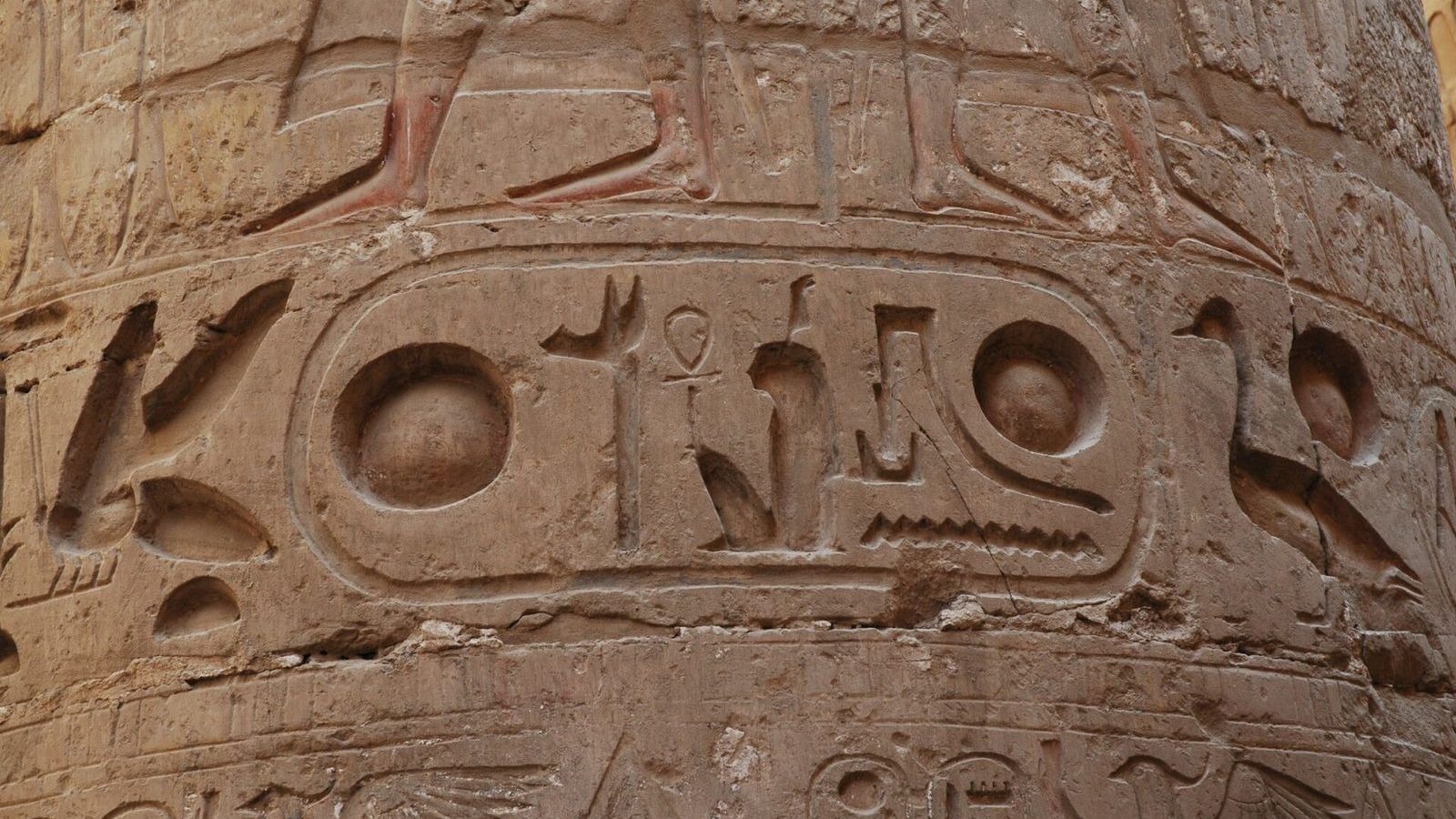
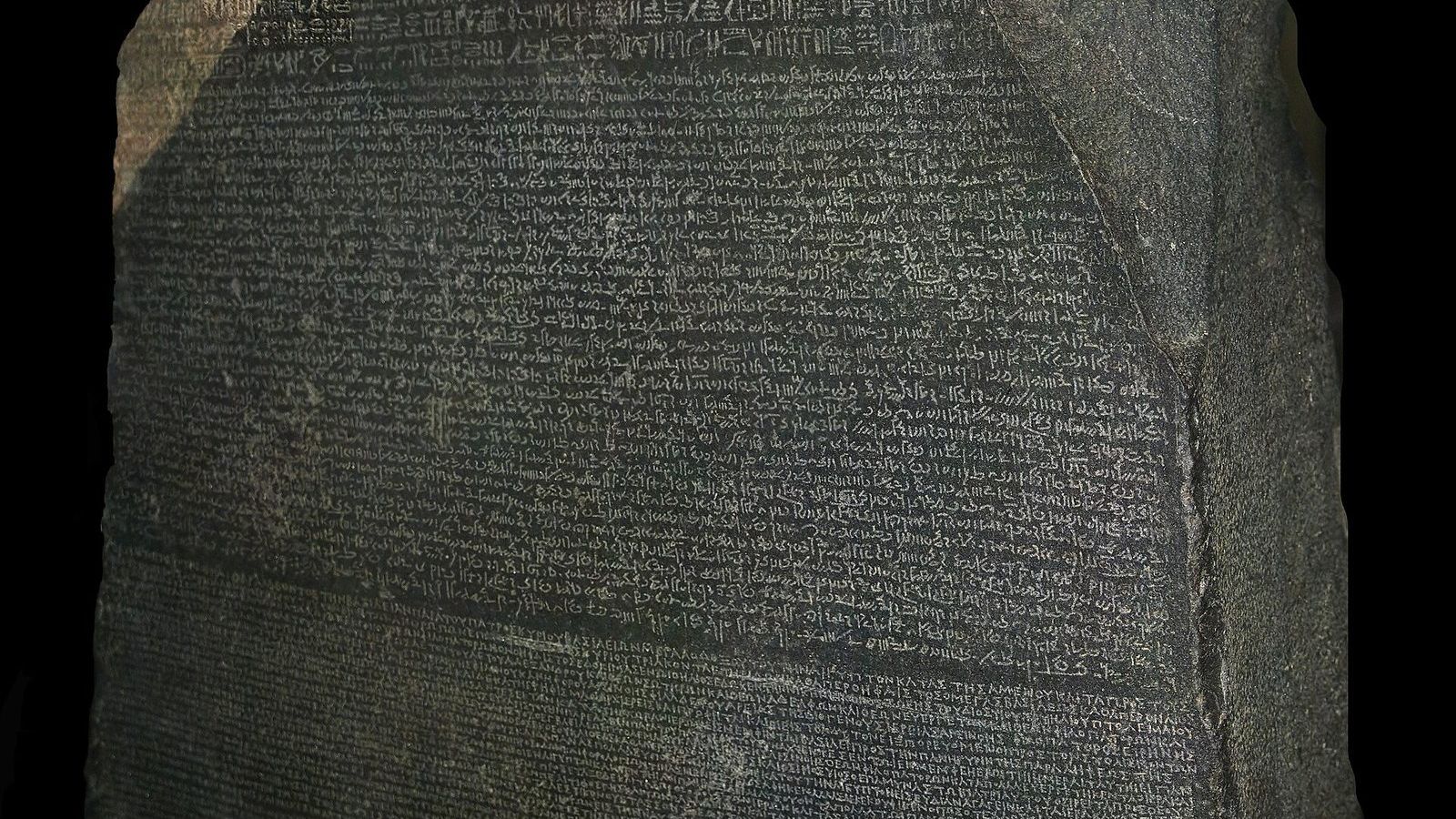
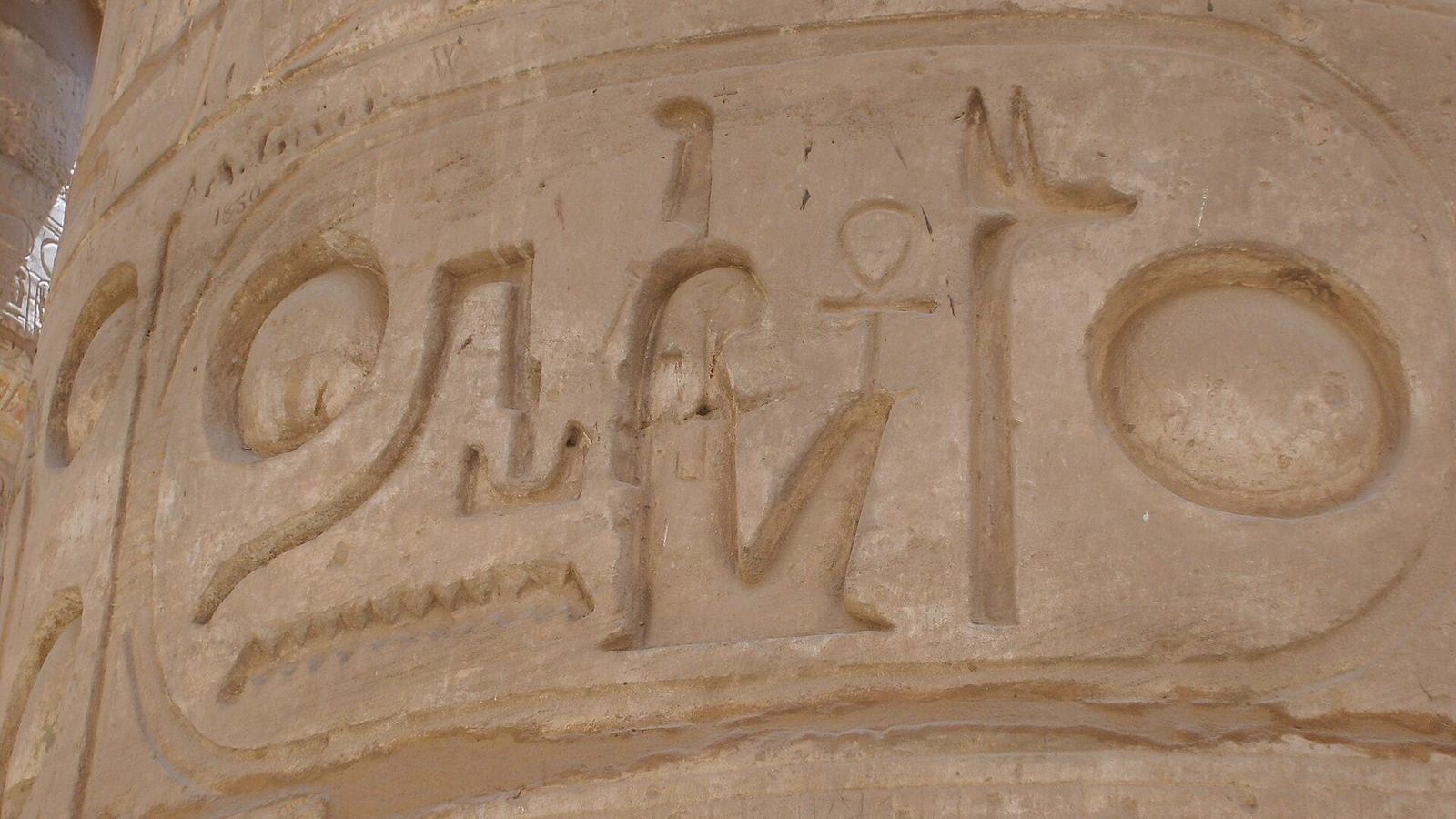
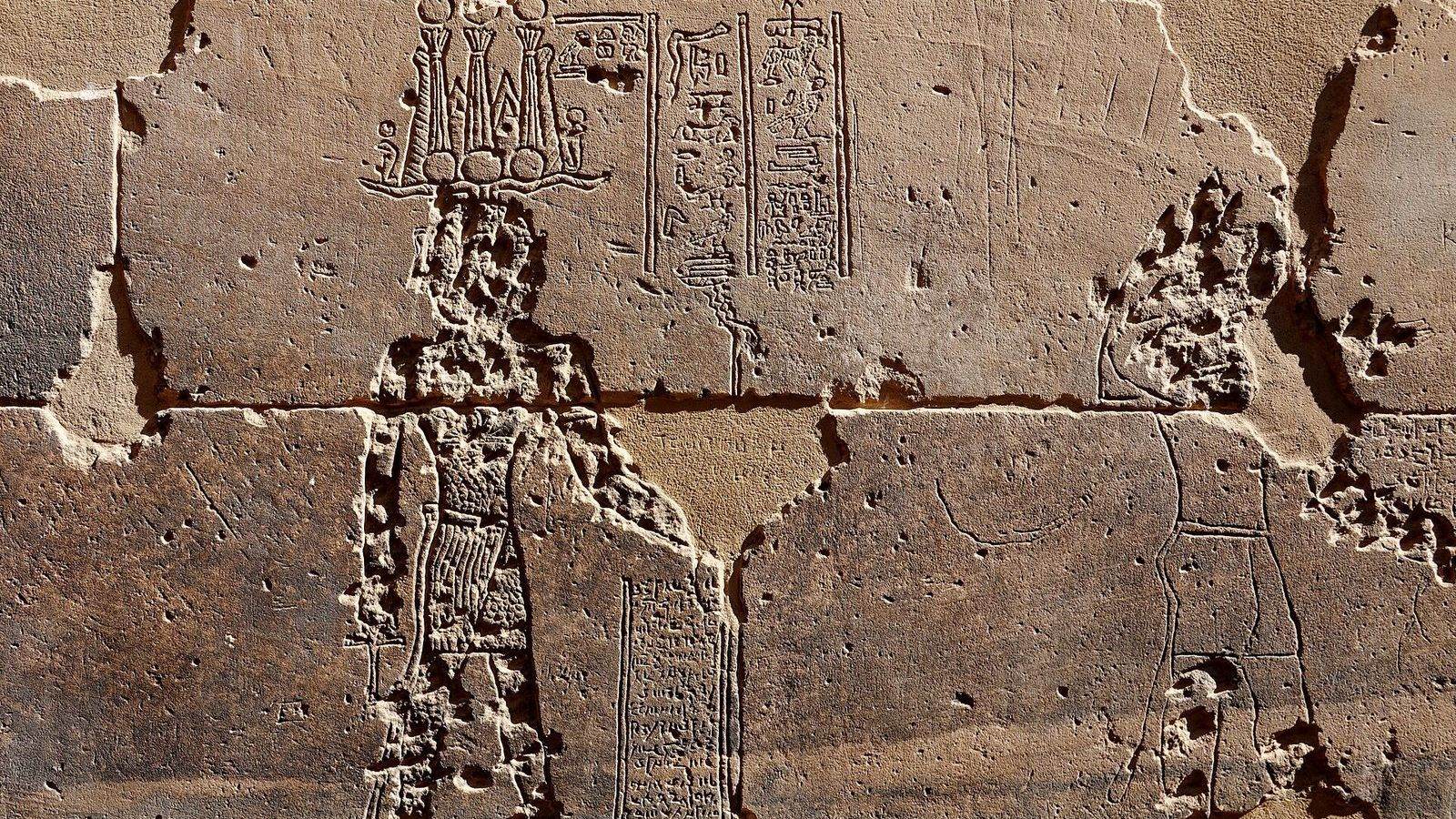
 Image: Olaf Tausch (CC BY 3.0); the graffito of Esmet-Akhom on the Gate of Hadrian at Philae
The last person who could read hieroglyphs
The temple of Isis at Philae stood on an island just above the First Cataract of the Nile, at the southern edge of Egypt. Today it stands on the neighbouring island of Agilkia, to which it was moved stone by stone in the 1970s when the Aswan High Dam flooded the original site. On the north wall of a small gateway beside the main temple, known as the Gate of Hadrian, is a roughly cut figure of a god in a feathered crown, and beside the figure, a few lines of hieroglyphs and a few lines of Demotic. The hieroglyphs say, in effect, this is Mandulis, lord of the Abaton, the great god; and they are signed by a man named Esmet-Akhom, son of Esmet, second priest of Isis, and dated to the birthday of Osiris in the year 110 of Diocletian. That year is AD 394, and the day is 24 August.
How we know it is the last
Hieroglyphs had been written in Egypt for about 3,400 years by then, since the labels of tomb U-j at Abydos around 3300 BC. No dated hieroglyphic text later than this one has been found anywhere, and Egypt has been searched thoroughly. The script did not die out gradually across the country; it had already retreated to a few temples, and Philae was the last of them. The Demotic lines next to the figure are part of the same graffito, and Demotic itself lasted a little longer at Philae: the last dated Demotic text, also a graffito there, is from 2 December AD 452.
So the claim in the title is slightly stronger than the evidence. Esmet-Akhom is the last person known to have written hieroglyphs, and there may have been colleagues who could read them for a few more decades. After the middle of the fifth century, nobody could.
Why Philae
By the end of the fourth century AD, Egypt had been a Roman province for four hundred years and Christian for about a hundred. In 391 and 392 the emperor Theodosius issued laws that closed the pagan temples of the empire and banned sacrifice. In Alexandria the Serapeum was destroyed by a Christian crowd in 391. The temples of the valley had been losing their income for a century before that; the Roman state had taken over their land, and the priesthoods that had kept the temple script alive had shrunk to a few families.
Philae survived because of its neighbours. The Blemmyes and the Nobatae, the peoples of Lower Nubia south of the cataract, were not Roman subjects and not Christians, and they worshipped Isis. Under a treaty with Rome they were allowed to visit her temple and to borrow her statue for processions. Mandulis, the god of Esmet-Akhom's figure, was a Nubian god worshipped at Kalabsha further south. The priests of Philae served a Nubian clientele at a Roman frontier, and that kept the temple open for more than a century after the laws of Theodosius. It was finally closed by the emperor Justinian in the 530s, when the general Narses removed the statues to Constantinople and the priests were imprisoned. A church was built inside.
Who Esmet-Akhom was
The family of Esmet is known from other graffiti at Philae. They were a dynasty of priests who had served Isis for generations, with Egyptian names that were already old-fashioned in Roman Egypt. The names mean the one who belongs to the mother, after a form of Isis. The graffiti that they left are mostly in Demotic and record acts of worship, visits, and the dates on which they made the figure of a god on the wall. Esmet-Akhom's hieroglyphic lines are brief and the signs are clumsy, but they are correct. He could still write a dedication in the temple script, and he dated it by the era of Diocletian, which the Egyptian church still uses today as the era of the martyrs.
What was lost
The language did not die with the script. Egyptian went on being spoken and was written in Greek letters with a few extra signs as Coptic, the language of the Egyptian church, in which the Bible, the lives of the saints, and a vast literature of monastic letters were written. Coptic was still a spoken language in parts of Upper Egypt in the seventeenth century, and it is still used in the liturgy. It was Coptic that gave Jean-François Champollion the sounds of the words when he read the hieroglyphs again in 1822.
What was lost was the knowledge of how the signs worked. Within a century of Esmet-Akhom, a Greek writer in Egypt named Horapollo produced a book explaining hieroglyphs as symbols of ideas, in which a few real values survive among invented ones. That book shaped what Europe believed about the script for 1,300 years and misled every scholar who tried to read it before the Rosetta Stone was found in 1799.
The length of the silence
From Esmet-Akhom's graffito to Champollion's letter of 27 September 1822 is 1,428 years. For comparison, the hieroglyphic script was in use for about 3,400 years, which is more than twice as long as it was unreadable. The script had outlived the independence of Egypt by nearly seven hundred years, the Ptolemies by more than four hundred, and the old religion's legal existence by three. It ended in a graffito by a priest with a Nubian congregation, at the farthest edge of the country, on a feast day of Osiris.
Unit 3 of the Egyptology Masterclass tells the story of the decipherment and ends with an excursion on the Philae graffito and the survival of the language in Coptic. Unit 12 places the end of the temples in the history of Roman Egypt, and Unit 8 uses the date 24 August AD 394 as the close of its three-thousand-year narrative.